On this page
- Shopify development cost at a glance
- What Shopify itself charges in 2027
- Shopify Plus cost, and when it is worth it
- The line items behind a Shopify build
- Hire Shopify developer cost: rates in the US, UK, Australia and India
- Worked example: the year-one cost to build a Shopify store
- Ongoing costs most quotes leave out
- What pushes a Shopify website cost up (or down)
- How to read a Shopify development quote
- Frequently asked questions
- What we’d do first
Ask three vendors to quote the same Shopify store and it is normal to get back $6,500, $38,000 and $112,000. None of them is a scam, and none is obviously wrong. They are pricing three different projects and calling all three “a Shopify build.”
That is the real problem with Shopify development cost: the number means nothing until you know what is in it. In 2027 a small store with a customized theme typically costs $3,000 to $50,000 to build, depending mostly on where your team is based. A complex Shopify Plus Services build with integrations runs $17,500 to $300,000 or more. On top of that you pay a monthly platform fee, apps and upkeep. Below is the line-by-line breakdown we use when we scope these projects ourselves, with sourced platform prices, regional rates for the US, UK, Australia and India, and a worked example budget you can copy.
Key takeaways
- Shopify’s own fees are the small part of total Shopify development cost. Plans run $29 to $299 a month on annual billing, and Plus starts at $2,300 a month on a 3-year term.
- Hours drive the budget. Almost every quote is just hours multiplied by a rate, so compare hours and scope, not totals.
- The same 250-hour project can cost about $6,000 with an Indian agency or about $50,000 with a US agency. Location is the biggest price lever you control.
- Budget for year one, not launch day. In our worked example, first-year apps, fees and upkeep add 50% to 78% on top of the build.
- Plus rarely pays for itself through lower card rates alone. Move to Plus for its features, not to save on fees.
Shopify development cost at a glance
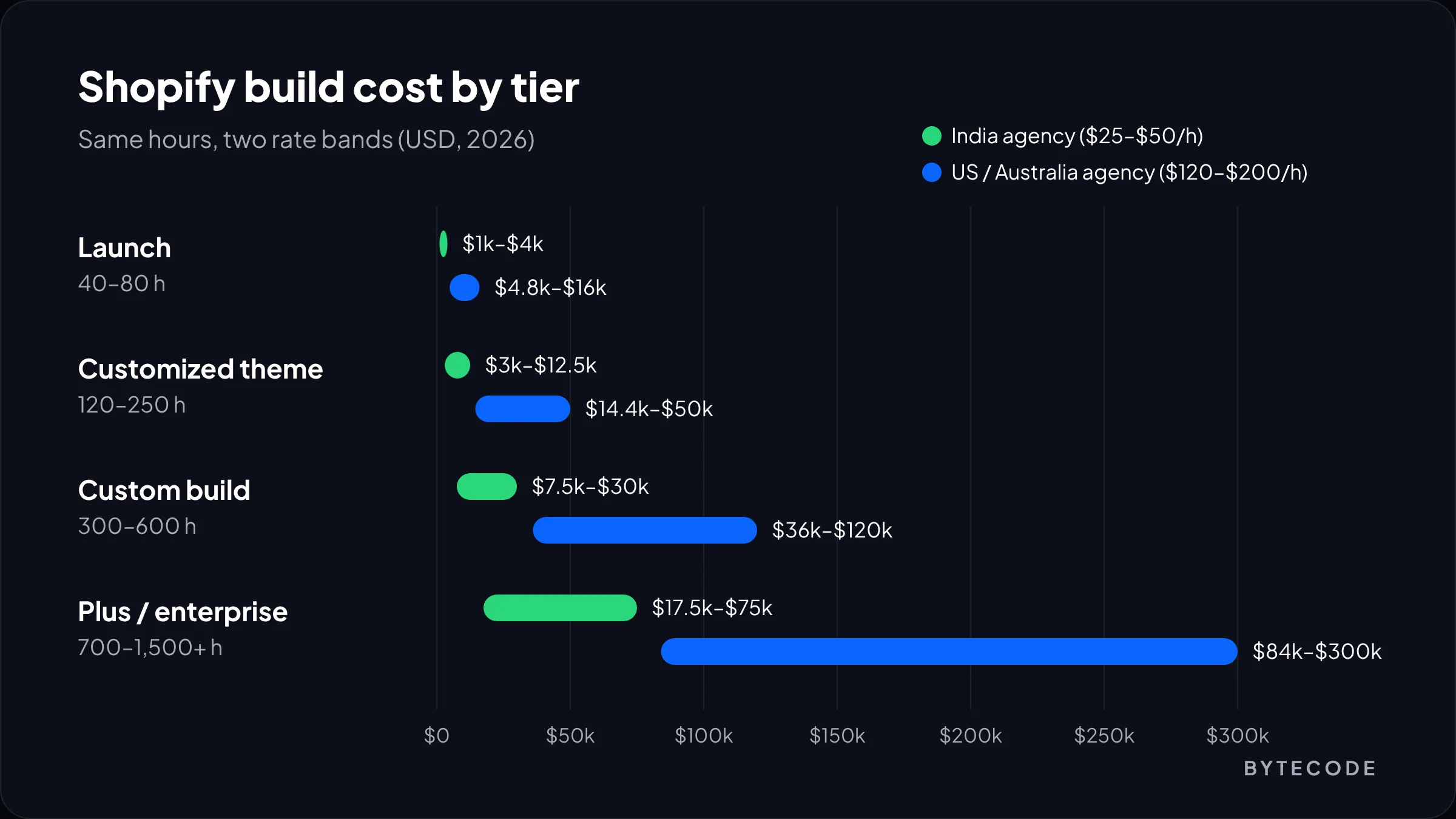
Expect to pay $1,000 to $16,000 for a basic theme setup, $3,000 to $50,000 for a customized theme store, $7,500 to $120,000 for a custom theme with integrations, and $17,500 to $300,000 for an enterprise or Plus build. The width of each range is mostly geography: the tier sets the hours, and the rate turns hours into Shopify development cost.
We scope in hours, then apply a rate. The table multiplies typical hour ranges by the agency rate bands from the regional section below. These are planning numbers, not quotes.
| Project tier | What you get | Typical hours | India agency ($25–$50/h) | UK agency ($60–$150/h) | US or Australia agency ($120–$200/h) |
|---|---|---|---|---|---|
| 1. Launch | Free or premium theme, brand styling, up to ~100 products, payments, shipping, basic SEO | 40–80 | $1,000–$4,000 | $2,400–$12,000 | $4,800–$16,000 |
| 2. Customized theme | Premium theme reworked with custom sections, metafields, filters, reviews, email flows, data import | 120–250 | $3,000–$12,500 | $7,200–$37,500 | $14,400–$50,000 |
| 3. Custom build | Bespoke theme from design files, subscriptions or bundles, ERP or 3PL integration, migration with redirects | 300–600 | $7,500–$30,000 | $18,000–$90,000 | $36,000–$120,000 |
| 4. Plus or enterprise | Plus checkout extensions, Shopify Functions, B2B, multiple markets, custom apps, headless options | 700–1,500+ | $17,500–$75,000 | $42,000–$225,000 | $84,000–$300,000 |
Timelines follow the same tiers, from 2 to 4 weeks for a theme setup to 4 to 9 months for an enterprise Plus build. We show hours as well as totals because hours are the part you can check. If a Tier 2 quote implies 600 hours, or 60, ask why.
What Shopify itself charges in 2027
Shopify’s subscription is the smallest line in most budgets: $29, $79 or $299 a month on annual billing for Basic, Grow and Advanced. Paid monthly, those become $39, $105 and $399. Those are the current US prices on Shopify’s pricing page.
What changes between plans is less the subscription and more the fees on every sale. If you use Shopify Payments, the online card rate falls from 2.9% + 30¢ on Basic to 2.7% + 30¢ on Grow and 2.5% + 30¢ on Advanced. If you use a third-party gateway instead, Shopify adds its own transaction fee: 2% on Basic, 1% on Grow and 0.6% on Advanced.
- Basic ($29/mo annual): fine for testing demand, but it has no extra staff accounts.
- Grow ($79/mo annual): where most of the small brands we work with land. It includes 5 extra staff accounts and a lower card rate.
- Advanced ($299/mo annual): worth it once card volume is high enough that the 0.2-point rate cut covers the extra $220 a month. That happens at about $1.3M a year in online card sales.
- Plus (from $2,300/mo): covered in its own section below.
Two smaller platform costs are worth putting in the spreadsheet now. A domain costs roughly $10 to $30 a year, and Shopify Messaging includes 10,000 email sends a month before charging $1 per 1,000. Both figures come from Shopify’s own cost guide.
Watch out: card fees are a percentage of revenue, so they quietly grow into one of your largest costs. At $600,000 a year in online sales with a $60 average order, Grow’s 2.7% + 30¢ comes to about $19,200 a year, roughly 20 times the plan fee. Count it as a cost of sale, not as part of your Shopify development cost.
Shopify Plus cost, and when it is worth it
Shopify Plus starts at $2,500 a month on a 1-year term or $2,300 a month on a 3-year term. Higher-volume or more complex businesses may move to a variable platform fee that depends on revenue and business model. That comes straight from the Shopify Plus plan page in the Help Center, which also lists local-currency prices:
| Billing currency | 1-year term (per month) | 3-year term (per month) |
|---|---|---|
| USD | $2,500 | $2,300 |
| GBP | £1,950 | £1,800 |
| AUD | A$4,000 | A$3,700 |
| INR | ₹190,000 | ₹175,000 |
On Plus, the licence is only part of your Shopify development cost. Shopify does not publish the variable fee percentages, so if your revenue is high, ask sales for the exact formula before you sign. Plus builds also take longer, because the features you are paying for need building: checkout extensibility, Shopify Functions for custom discounts and shipping logic, B2B price lists, and expansion stores. Each of those features is development work.
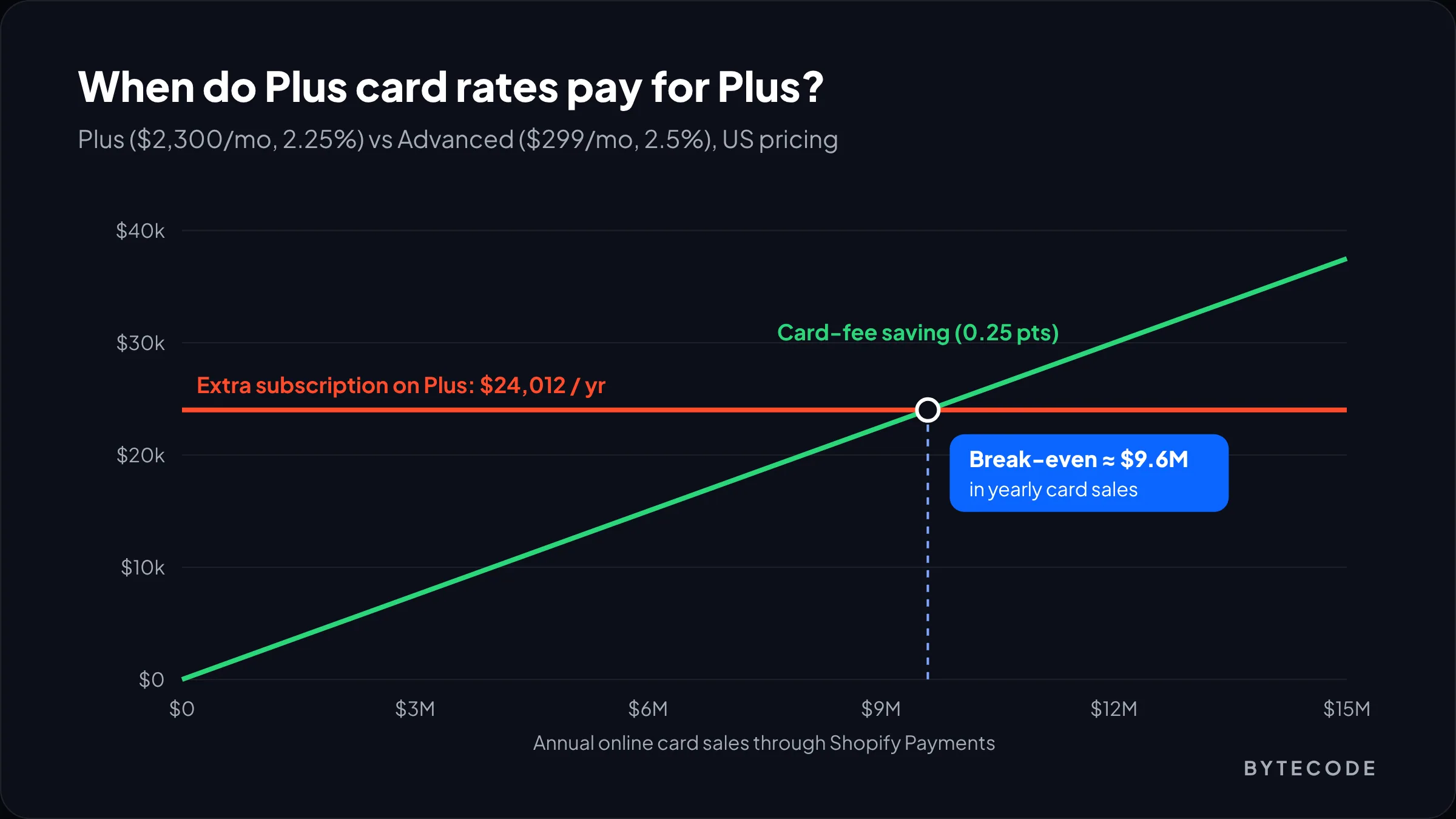
Here is the math most “is Plus worth it” articles skip. On US pricing, Plus brings the online card rate down to 2.25% + 30¢, against 2.5% on Advanced. That 0.25-point saving has to cover about $24,000 a year in extra subscription ($2,300 minus $299, times 12). You only break even at roughly $9.6M a year in online card sales. Below that, you are paying for Plus features, and that is fine as long as you actually need them.
We compare the two plans feature by feature in Shopify Plus vs Advanced. Our short rule: if you are under about $1M in annual revenue and have no B2B or multi-store needs, skip Plus for now.
The line items behind a Shopify build
Every honest quote breaks down into the same seven phases. If a Shopify development cost estimate does not show them, ask. It is the fastest way to tell whether two quotes describe the same project.
Discovery and UX (8–12% of hours)
Sitemap, user flows, product data model, app selection and a written scope. It is the cheapest place to find out that your 400 products need 9 metafields each.
Design (10–20%)
Skipped or kept small on a theme-based build. On a custom build, expect desktop and mobile designs for the homepage, collection page, product page, cart and any landing templates.
Theme development (35–45%)
The largest line: building or customizing Liquid sections, wiring metafields into templates, filters, and small UI details that eat time, like sticky add-to-cart and variant swatches. A premium theme from the Theme Store costs anywhere up to about $500 one-time, and it is licensed to a single store.
Apps and integrations (10–20%)
Subscriptions, reviews, search, ERP, 3PL or accounting connectors. One-click apps take an hour. A two-way ERP sync with custom fields can take 80.
Content and data migration (5–10%)
Product, customer and order imports, URL redirects and cleanup. On a replatform, the redirect map protects your search traffic. It is not optional.
QA, accessibility and speed (8–12%)
Cross-device testing, real-payment checkout tests, accessibility fixes and a Core Web Vitals pass. On most stores we audit, the first speed problem is an oversized hero image or an app script loading on every page.
Launch and handover (3–5%)
DNS, final redirects, analytics checks, training and documentation.
Hire Shopify developer cost: rates in the US, UK, Australia and India
Hourly rates range from under $25 for many Indian agencies to $150 to $200 or more for US and Australian agencies, and that spread moves your budget more than anything else. Here is what we found in published data for October 2027.
| Region | Freelance, mid-level (USD/h) | Agency (USD/h) | Where the agency figure comes from |
|---|---|---|---|
| United States | $62–$100 | $120–$205 (mid-level) | Second Talent agency bands |
| United Kingdom | $38–$62 | Mostly $50–$99, many $100–$199 | Clutch London listings |
| Australia | $60–$97 (with NZ) | Most common band $150–$199 | Clutch Australia listings |
| India | $15–$38 | Mostly under $25 or $25–$49 | Clutch India listings |
The freelance figures come from Second Talent’s October 2027 rate tables, which also put US agency rates at $95 to $160 for junior and $155 to $260 for senior work. The agency bands come from counting the rate bands agencies list on Clutch’s current ranking pages for London, Australia and India. On the Australian page, 10 of the roughly 30 agencies shown list $150 to $199 an hour. On the Indian page, 23 of 29 list under $50.
So what does it cost to hire a Shopify developer? For a solid mid-level freelancer, budget $40 to $100 an hour in the US, UK or Australia, and $15 to $40 in India. For an agency that brings a project manager, a designer and QA, budget roughly double that.
Freelancer or agency? A good freelancer is excellent value for Tier 1 and many Tier 2 projects. Once design, development, integrations and QA run in parallel, you are managing a team yourself, and an agency or hybrid model earns its margin. We cover vetting in our guide on how to hire a Shopify developer.
From our team: this hybrid model is what our two offices are set up for. Strategy, UX and client contact sit with the US team in Alpharetta, and the build hours sit with the team in Mohali. You get one accountable lead in your time zone and an Indian rate on most of the hours, which is where most of the cost sits.
Worked example: the year-one cost to build a Shopify store
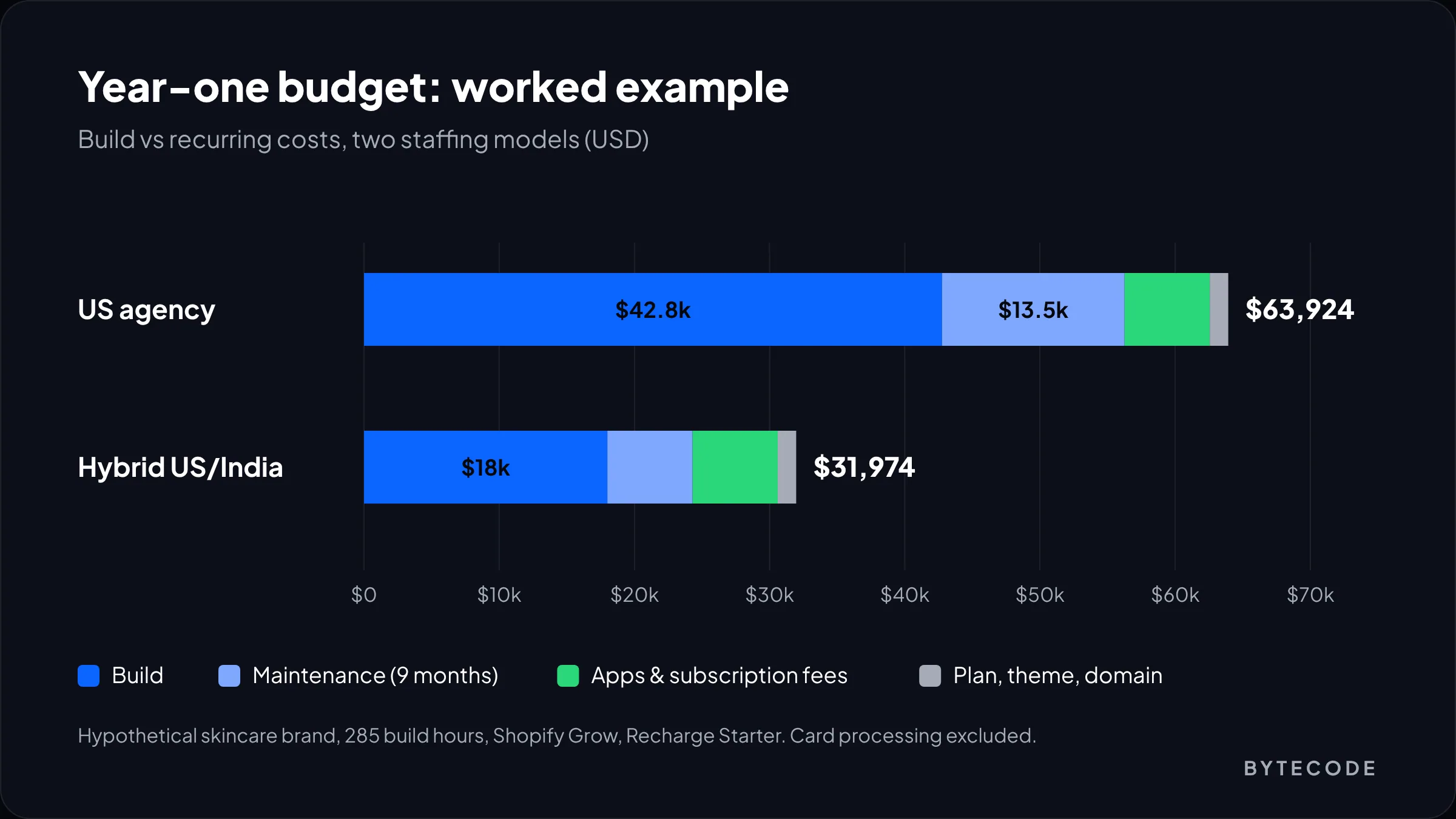
Here is a complete, clearly hypothetical Shopify development cost budget. Say you run a US skincare brand launching on Shopify with about 120 products, subscriptions on 4 hero products, and a forecast of $10,000 a month in subscription revenue across 250 orders. You want a premium theme reworked to look custom (Tier 2, near the top of the range).
Build hours
- Discovery and UX: 30 hours
- Theme customization and custom sections: 120 hours
- Metafields, filters and product page logic: 50 hours
- Subscription app setup and theme integration: 25 hours
- Product and customer import: 20 hours
- QA, accessibility and speed: 25 hours
- Launch, redirects and training: 15 hours
That is 285 hours. Here is year one under two staffing models:
| Line item | Basis | US agency | Hybrid US/India team |
|---|---|---|---|
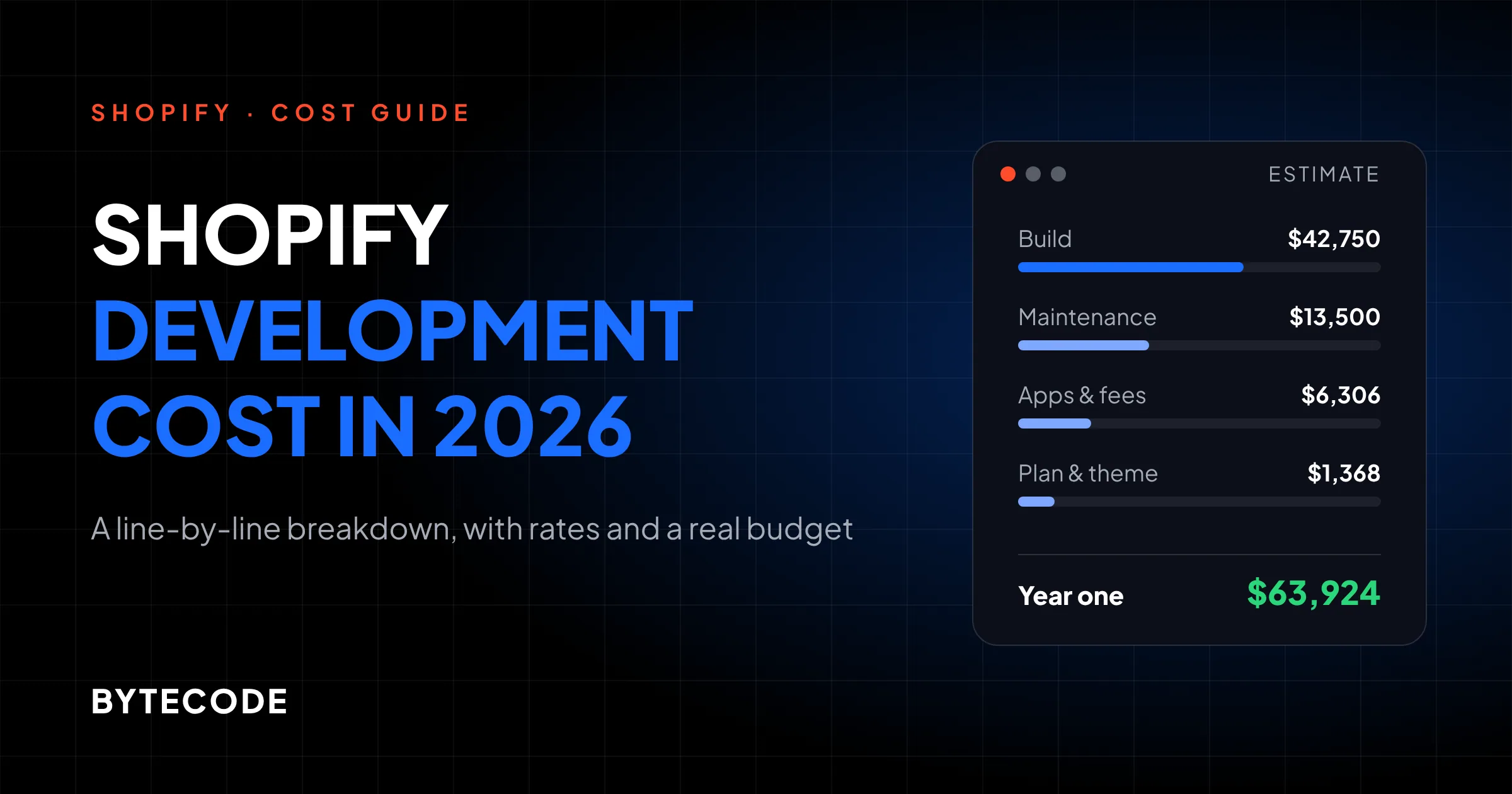
| Build | 285 h at $150 / 60 h at $150 + 225 h at $40 | $42,750 | $18,000 |
| Premium theme licence | One-time, assumed | $400 | $400 |
| Domain | Per year | $20 | $20 |
| Shopify Grow plan | $79 × 12, annual billing | $948 | $948 |
| Recharge Starter subscription app | $99 × 12 | $1,188 | $1,188 |
| Recharge processing fees | 1.49% + 19¢ on $10k/mo, 250 orders | $2,358 | $2,358 |
| Email beyond free sends | 40k sends/mo, 30k paid at $1 per 1,000 | $360 | $360 |
| Other apps (reviews, search, SEO, upsells) | Allowance of $200/mo | $2,400 | $2,400 |
| Post-launch maintenance | 10 h/mo for 9 months at $150 / $70 | $13,500 | $6,300 |
| Year-one total | $63,924 | $31,974 |
Recharge fees are the Starter rates on Recharge’s pricing page. Card processing is left out because it scales with sales, not the project.
Two things stand out. The build is only 67% of year one with a US agency and 56% with the hybrid team, so the launch price understates real spend. And the hybrid model halves the cost without touching scope.
Want this budget filled in for your store?
Send us your product count, apps and target launch date, and we will return an hour-by-hour estimate within two working days.
Ongoing costs most quotes leave out
After launch, a small store typically spends somewhere between $500 and $2,500 a month. That is our own planning sum: Grow at $79, a few hundred dollars of apps, and 5 to 15 maintenance hours. It climbs fast with subscriptions, extra markets or Plus.
- App creep. Stores add apps and rarely remove them. Audit quarterly, since each one costs money and often speed.
- Theme updates. Heavy customization makes theme updates harder. Keep custom code in separate sections and snippets.
- Platform changes. Shopify retires older features on fixed dates. The Scripts-to-Functions move and checkout extensibility created unplanned work for many stores.
- Small requests. Banners, landing pages and promo logic. A retainer is usually cheaper than ad hoc rates.
We break down retainer models in our guide to Shopify store maintenance.
What pushes a Shopify website cost up (or down)
Four things move Shopify website cost more than anything else: custom design versus a theme, the number and depth of integrations, data migration complexity, and how many markets or storefronts you launch. Product count matters less than people expect: 50 products and 5,000 cost about the same to template. The extra cost with 5,000 is data cleanup.
What raises the price
- Custom design files for every template instead of a theme
- Two-way ERP, PIM or warehouse integrations
- Multiple markets with different catalogs, prices and languages
- Custom app work: Functions, checkout UI extensions, private apps
- Headless storefronts (Hydrogen or Next.js), which roughly double front-end effort
What lowers it without hurting quality
- Starting from a well-built premium theme and customizing only the templates that sell
- Having product data, photos and copy ready before development starts
- One decision-maker who approves designs within 48 hours
- Phasing: launch the core store, then add extras once real data shows what customers use
If you are still choosing a platform, our comparison of Shopify vs WooCommerce includes a total cost of ownership view.
How to read a Shopify development quote
A good Shopify development cost quote shows hours by phase, names who does the work, lists what is out of scope and states how changes are priced. If any of those four are missing, the low number is probably low because things are missing.
- Ask for hours by phase. Compare them against the line items above. A Tier 2 quote with 10 hours of QA is not cheap. It is untested.
- Check the rate behind the total. Divide the total by the hours. That number tells you who you are really hiring.
- Read the exclusions. Copywriting, product photography, data cleanup and app subscriptions are commonly excluded, and they are real costs.
- Agree the change process. Know the hourly rate for out-of-scope work before you need it.
- Confirm what happens after launch. How long is the bug-fix window, and what does support cost after it?
Watch out: fixed-price quotes far below the ranges in our table usually end in one of two ways. Either the scope shrinks during the build, or the change requests start arriving the week before launch.
If you want a second opinion on a quote you already have, our Shopify development team will review it line by line.
Frequently asked questions
How much does it cost to have a Shopify store built?
In 2027, Shopify development cost for most small brands is $3,000 to $50,000 for a professionally built store, depending on customization and on where the team is based. A basic theme setup can cost as little as $1,000 with an offshore team, while a fully custom build with integrations from a US agency can pass $100,000.
How much does a Shopify developer charge per hour?
A mid-level freelance Shopify developer charges roughly $62 to $100 an hour in the US, $38 to $62 in the UK and $15 to $38 in India, according to Second Talent’s 2027 data. Agencies cost more because they include project management, design and QA, typically $120 to $205 an hour in the US.
How much does Shopify Plus cost per month?
Shopify Plus starts at $2,300 a month on a 3-year term, or $2,500 a month on a 1-year term. In the UK that is £1,800 or £1,950, and in Australia A$3,700 or A$4,000. Higher-volume businesses may pay a variable platform fee based on revenue, which Shopify quotes through its sales team.
Is Shopify cheaper than building a custom website?
Yes, for most stores. Shopify’s plan fee covers hosting, security updates and checkout, so your budget goes on design and features rather than infrastructure. A fully custom ecommerce platform also needs ongoing engineering just to stay secure and current, which usually costs more over three years than a Shopify plan plus apps.
How long does it take to build a Shopify store?
A theme-based store usually takes 2 to 4 weeks, a customized theme build 6 to 10 weeks, a custom theme 3 to 6 months, and a Plus or enterprise build 4 to 9 months. In our experience, the most common delay is not development. It is waiting on product data, photography and copy.
What are the monthly costs of running a Shopify store?
Most small stores pay the Shopify plan ($29 to $299 a month on annual billing) plus apps, which on the stores we see usually run a few hundred dollars a month, plus card fees of 2.5% to 2.9% + 30¢ per online sale. Maintenance comes on top: 5 to 15 developer hours a month is common, so multiply by your team’s hourly rate.
What we’d do first
Before you collect quotes, write down three things: your product count and data sources, every app or system the store must connect to, and the one or two page types that drive most of your revenue. Hand that same brief to every vendor and ask for hours by phase. You will get quotes you can actually compare, and the cheapest-looking one will often turn out to be the smallest project.
Then budget Shopify development cost for year one, not launch day. Take the build quote and add at least 50% for the plan, apps and upkeep. If that total is uncomfortable, phase the scope rather than squeezing the rate, because a cheaper team doing rushed hours costs more to fix later.
We have built and supported Shopify stores for brands like Delsey, EcoFlow, Kerbholz and Maker & Moss. If you want a line-item estimate for your own store, take a look at our Shopify development services and tell us what you are planning.