On this page
- How local SEO for AI search differs from map pack SEO
- Where AI Overviews, AI Mode, ChatGPT and Perplexity get local data
- Google Business Profile AI readiness: fill the fields models quote
- Reviews: the filter AI applies before it recommends anyone
- Citations and NAP consistency: mentions are the new links
- Local landing pages an AI can quote
- LocalBusiness schema: useful, but not a ranking trick
- Measuring near me visibility in AI answers
- Frequently asked questions
- What we’d do first
Ask Google’s AI Mode for “a bike shop near Roswell that can service a Shimano Di2 groupset” and you get two or three named shops, a line on why each one was picked, and a link or two. The shop sitting third in the map pack for “bike repair” may not be one of them. That gap is the whole reason local SEO for AI search exists as a separate conversation.
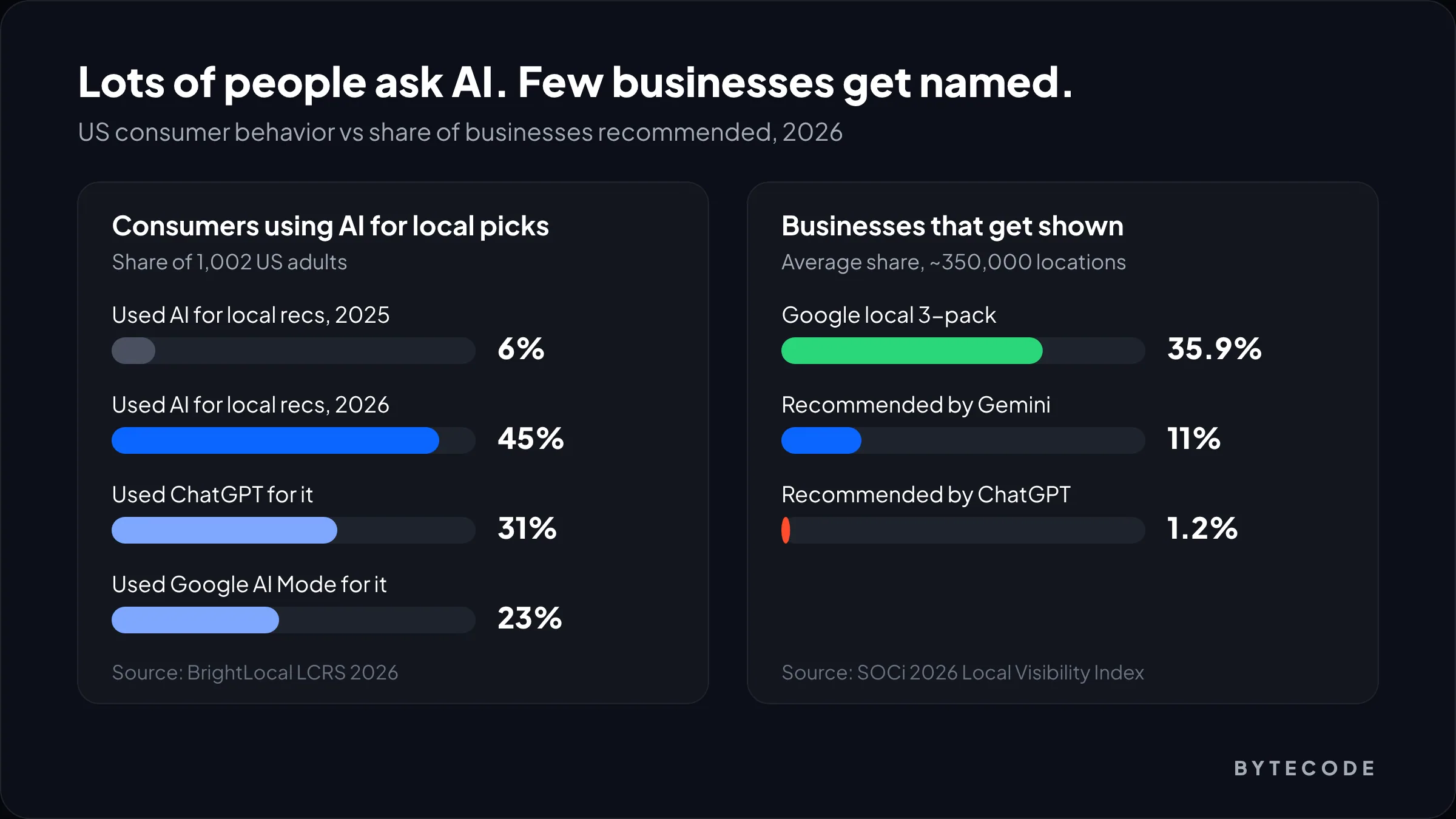
The short answer: AI engines pick local businesses from the same raw material as Google Maps (your Business Profile, your reviews, your listings and your website), but each engine weighs that material differently, and all of them are far choosier than the map pack. SOCi’s 2026 Local Visibility Index, built on roughly 350,000 locations, found businesses appear in Google’s 3-pack 35.9% of the time on average, against 11.0% for Gemini recommendations and 1.2% for ChatGPT. Below: where each engine gets local data, what we fix first, a schema example, and how to measure visibility without a rank tracker.
Key takeaways
- AI answers name far fewer businesses than the map pack. In SOCi’s 2026 data, ChatGPT recommended 1.2% of businesses studied, while 35.9% made Google’s 3-pack.
- Google’s AI features lean on your Business Profile. ChatGPT and Perplexity lean more on your website, Yelp, Foursquare-style listings and category directories.
- Reviews act as a gate. Recommended locations averaged 4.3 stars in ChatGPT and 4.2 in Perplexity, and review text supplies the reasons the AI gives.
- Schema helps machines read your facts, but Google says no special markup is needed for AI features. Consistency across sources matters more.
- Measure with a fixed monthly prompt panel across four engines. Search Console will not separate AI traffic for you.
How local SEO for AI search differs from map pack SEO
A map pack lists three businesses for a query; an AI answer names a handful for a whole conversation and explains why. To be named, the engine needs enough consistent, specific evidence about you to justify the sentence it writes. Three things make that harder than ranking in Maps.
First, the answers move. Whitespark’s guide to AI Mode for local businesses (May 2026) notes that AI Mode keeps context across follow-ups and fans one prompt out into several searches, and that two people in the same spot can get different answers. There is no stable “position 2” to defend.
Second, AI Overviews already sit on top of most local queries. Whitespark’s Q1 2025 study, cited in that guide, found them on 68% of local searches on average, and a Ziptie study it quotes put a top-10 page’s chance of also appearing in the Overview at about 25%. That is the core problem of AI Overviews local SEO: ranking is the entry ticket, not the prize.
Third, people really do ask AI now. BrightLocal’s Local Consumer Review Survey 2026 (1,002 US adults, March 2026) found 45% of consumers used AI tools for local recommendations, up from 6% a year earlier. ChatGPT led at 31%, with Google’s AI Mode at 23%. Yet 97% of AI users sometimes double-check those picks against real reviews. The AI shortlists you; your ordinary profiles still close the deal.
Our position: don’t start a separate “AI local SEO” program with its own vendor and dashboard. Run the local program you should have been running anyway, then fix what AI engines punish harder than Maps: contradictory business data, vague review text, and websites that never say plainly what you do and where.
Where AI Overviews, AI Mode, ChatGPT and Perplexity get local data
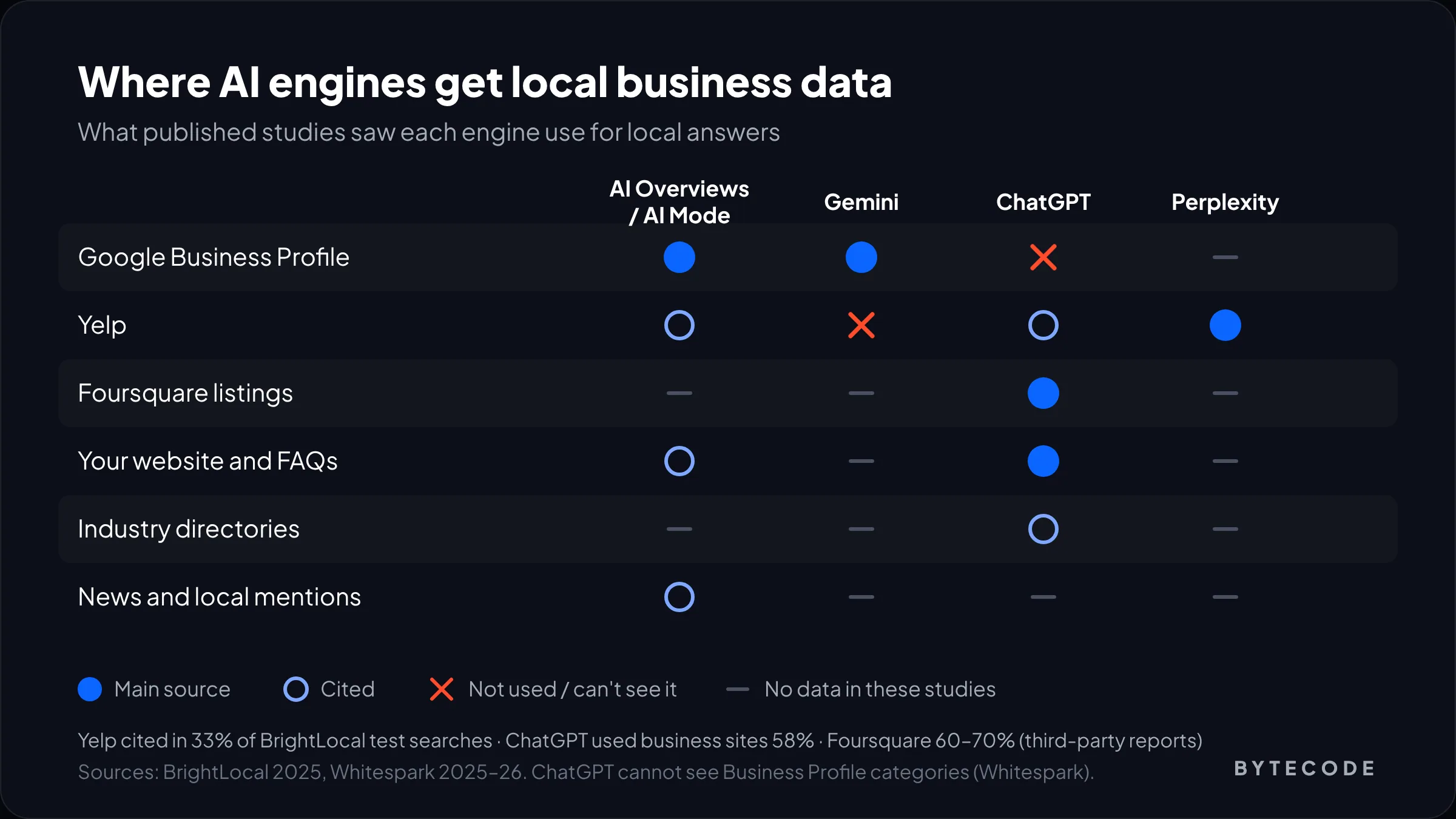
Google’s AI features draw first on Google’s own Business Profile data, while ChatGPT and Perplexity rely more on business websites, review sites and third-party listings. That split decides where your effort goes.
On Google’s side, Whitespark lists AI Mode’s sources: Business Profile data (ratings, review volume, pricing, hours), review sites like Yelp, mentions in news and community pages, and business websites, especially FAQ content. Google’s own AI features documentation (updated December 2025) adds that a page only needs to be indexed and snippet-eligible.
Outside Google, the evidence is thinner. BrightLocal’s study of AI search sources ran 20 searches across 10 industries on AI Mode, Gemini, Perplexity and ChatGPT. Yelp was a source in 33% of searches, Perplexity used it in every industry, and Gemini never cited it directly. The piece also cites BrightLocal’s earlier finding that ChatGPT drew on business websites 58% of the time, plus third-party reports (not BrightLocal’s data) that 60% to 70% of ChatGPT’s local results come from Foursquare. For dentists, ChatGPT used only dental directories.
| Engine | Leans on most | What we change first |
|---|---|---|
| AI Overviews and AI Mode | Business Profile fields, Google reviews, Yelp, local mentions, your site’s FAQ content | Profile completeness, review flow, a location page that answers real questions |
| Gemini | Google’s own data, including Business Profile categories | Primary and additional categories, services, attributes |
| ChatGPT | Business websites, Foursquare-style listings (reported), category directories | Website clarity, Foursquare and directory listings, NAP consistency |
| Perplexity | Yelp and other review sites, plus the open web | Yelp profile, review text, citations on local and industry sites |
One detail from Whitespark’s 2026 Local Search Ranking Factors survey (47 experts, 187 factors) shows the split. Darren Shaw would score Business Profile additional categories at zero for ChatGPT but about 3 out of 5 for AI Mode and Gemini, because only Google sees that field. Profile work alone does little for ChatGPT. Website and listing work does.
Watch out: 20 searches is a small sample, and engines change sources without notice. Before paying for any listing, run your own category’s prompts and see which sources each engine cites for your town.
Google Business Profile AI readiness: fill the fields models quote
For Google’s AI features, your Business Profile is the primary record of your business, so completeness is your biggest lever. Google’s help page on improving local ranking says results rest on relevance, distance and prominence, and that complete, accurate profiles are more likely to show. It is also blunt about paid shortcuts: “There’s no way to request or pay for a better local ranking on Google.”
Most profiles we audit are not empty, just half-finished: right category, right hours, and nothing an AI could use to answer a specific question.
Categories and services
Pick the narrowest accurate primary category, add every additional category that reflects real revenue, and fill in services with a sentence each. “Di2 electronic shifting setup” in a service list gives an AI something to match against a long prompt. “Repairs” does not.
Attributes, hours and special hours
Attributes such as accessibility, parking, payment types and appointment-only are exactly what conversational prompts ask about (“wheelchair accessible”, “takes walk-ins”). Google’s help page calls out keeping special hours current. Whitespark’s guide shows the cost of gaps: an AI told a searcher a restaurant allowed dogs, based on another business’s policy. With nothing from you, the AI guesses from someone else.
Description, photos and products
Write the description as plain facts: what you do, the neighborhoods you serve, the brands you carry. Skip the adjectives. Keep adding real photos of the storefront, team and work. For many locations, work in bulk from one master spreadsheet that also feeds your website.
From our team: we never stuff keywords into the business name. It can lift map rankings for a while, but it breaks the match between your profile, signage and other listings, which is exactly what AI engines check. It also gets profiles suspended.
Reviews: the filter AI applies before it recommends anyone
Reviews work as a gate, not a tiebreaker: low-rated businesses rarely get recommended, and your review text becomes the AI’s reasons. SOCi’s 2026 index found the locations AI engines recommended averaged 4.3 stars in ChatGPT, 4.2 in Perplexity and 3.9 in Gemini.
Text matters more than it used to. An AI explaining its pick reaches for specifics like “fixed my hydraulic brakes the same day”. A wall of “great service!” gives it nothing to quote.
BrightLocal’s 2026 survey shows the other half. Half of consumers trust AI to summarize reviews, but 59% still check the review profiles, and Google review use fell from 83% to 71% as other platforms grew. Reviews now feed the summary and have to survive the check.
How we ask for reviews
- Ask about the job, not the stars. “Would you mind mentioning what we fixed and how long it took?” produces reviews an AI can use.
- Keep a steady pace. Whitespark’s guide recommends building recent reviews steadily, not in bursts.
- Cover one non-Google platform. Pick the one your category’s AI answers actually cite, often Yelp, sometimes an industry directory.
- Reply to everything, negative ones included. Replies are public text too.
Citations and NAP consistency: mentions are the new links
Consistent name, address and phone (NAP) matters more for AI visibility than it has for map rankings in years. Whitespark’s survey found that three of the top five AI search visibility factors are citation factors, and Darren Shaw puts it plainly: “In AI SEO, mentions (citations) are the new link.”
A model that finds you on your website, Yelp, Foursquare and a local news story, all with the same details, can describe you with confidence. One that finds two addresses and three phone numbers has a reason to pick someone else.
| Citation type | Examples | What we do |
|---|---|---|
| Core platforms | Google Business Profile, Apple Business Connect, Bing Places, Yelp, Foursquare | Claim all of them, match NAP to the character, same hours and categories |
| Category directories | Industry sites your AI answers actually cite | Claim the two or three that show up in your prompt checks |
| Unstructured mentions | Local news, sponsorships, associations, supplier “where to buy” pages | Earn a few a quarter; make sure each one names your town |
| Old and duplicate data | Listings from a previous address, old phone numbers, closed locations | Find and fix or close them; these confuse models more than missing listings do |
Two traps catch most businesses: an old address that lives on in directories for years after a move, and call tracking numbers. If you use a tracking number on your profile, keep the main number everywhere else so the web still agrees on one.
Not sure what AI tools say about your business?
We will run a prompt panel across AI Mode, Gemini, ChatGPT and Perplexity for your locations and show you which sources they cite and where your data disagrees.
Local landing pages an AI can quote
Give every real location its own page, written so any paragraph could stand alone as an answer: what you do there, for whom, hours, how to get there, and prices where possible. This is what ChatGPT reads when it can’t see your Business Profile.
Structure beats length. In Whitespark’s 2026 survey, scannable content structure across the site ranked 10th for AI search visibility, the highest new factor that year. Their AI Mode guide also recommends answering customers’ real questions on your site, phrased the way they ask them.
Here is the outline we would use for a hypothetical bike shop location page:
- Opening paragraph: “[Shop name] Roswell is a full-service bike shop on Canton Street, open seven days, specializing in road and e-bike repair.”
- Services at this location, each with one sentence and a typical turnaround or starting price.
- Brands stocked and serviced, named, because people prompt with brand names.
- Hours, parking and access, matching the Business Profile exactly.
- Directions in local terms: landmarks and neighborhoods served.
- Five to eight FAQs written from real calls and emails (“Can you fit a bike the same day?”).
What we skip: city-swap pages. Forty near-identical “bike repair in [city]” pages for towns without a shop give an AI nothing to trust. If you serve an area without a storefront, write one service-area page explaining how it works (pickup, mobile service, travel fees).
The answer-first writing style is covered in our guide to generative engine optimization. On Shopify, we build location pages from a metaobject (address, hours, services, coordinates), so one template renders every store page and its schema; our post on Shopify metafields and metaobjects explains the data model. It is also the core of our hyper-local SEO for AI search service: one location record, pushed everywhere.
LocalBusiness schema: useful, but not a ranking trick
Add LocalBusiness schema to every location page, keep it identical to the visible page and Business Profile, and don’t expect it to get you cited on its own. Google’s AI features page says no special schema.org markup is needed for AI Overviews or AI Mode, and structured data should match visible content.
It is still cheap insurance against ambiguity. Google’s LocalBusiness structured data guide (updated September 2026) lists only name and address as required. It recommends geo with at least five decimal places, openingHoursSpecification, telephone with country code, url and a priceRange under 100 characters, plus the most specific subtype and one entity per location.
<script type="application/ld+json">
{
  "@context": "https://schema.org",
  "@type": "BicycleStore",
  "name": "Example Cycles Roswell",
  "url": "https://www.example.com/stores/roswell/",
  "telephone": "+1-770-555-0142",
  "priceRange": "$$",
  "address": {
    "@type": "PostalAddress",
    "streetAddress": "100 Example Street",
    "addressLocality": "Roswell",
    "addressRegion": "GA",
    "postalCode": "30075",
    "addressCountry": "US"
  },
  "geo": { "@type": "GeoCoordinates", "latitude": 34.02318, "longitude": -84.36159 },
  "openingHoursSpecification": [{
    "@type": "OpeningHoursSpecification",
    "dayOfWeek": ["Monday","Tuesday","Wednesday","Thursday","Friday","Saturday"],
    "opens": "09:00", "closes": "18:00"
  }]
}
</script>
All details are placeholders. On Shopify we render this from a snippet like snippets/location-schema.liquid fed by the location metaobject, so hours change in one place. Our Shopify SEO guide covers what your theme already outputs, so you avoid two conflicting blocks.
Watch out: don’t mark up your own star rating with aggregateRating. Google’s guide recommends review markup only for sites that collect reviews about other local businesses. Pasting your Google rating into your own schema adds risk and no benefit.
Measuring near me visibility in AI answers
No tool gives a reliable AI ranking for local queries, so run a fixed prompt panel monthly and add what Search Console, Business Profile Performance and GA4 already show. Expect a trend line, not a rank.
Start with what platforms report. Google counts AI feature appearances in Search Console’s Performance report under the Web search type, with no separate filter. Business Profile Performance shows calls, direction requests and website clicks per location. In GA4, open Reports > Acquisition > Traffic acquisition and filter session source for chatgpt.com, perplexity.ai and gemini.google.com. Small numbers, but the only direct AI signal you get.
Then build the panel. The near me searches AI engines now handle are longer than the old two-word versions, so write prompts the way customers talk:
- 10 to 15 prompts per location, mixing broad (“best bike shop near Roswell”) and specific (“who services Di2 near Roswell on a Sunday”)
- The same four engines every month: AI Mode, Gemini, ChatGPT and Perplexity
- Logged out where possible, with location set to the store’s area
- Record whether you are named, which competitors are, and which sources are cited
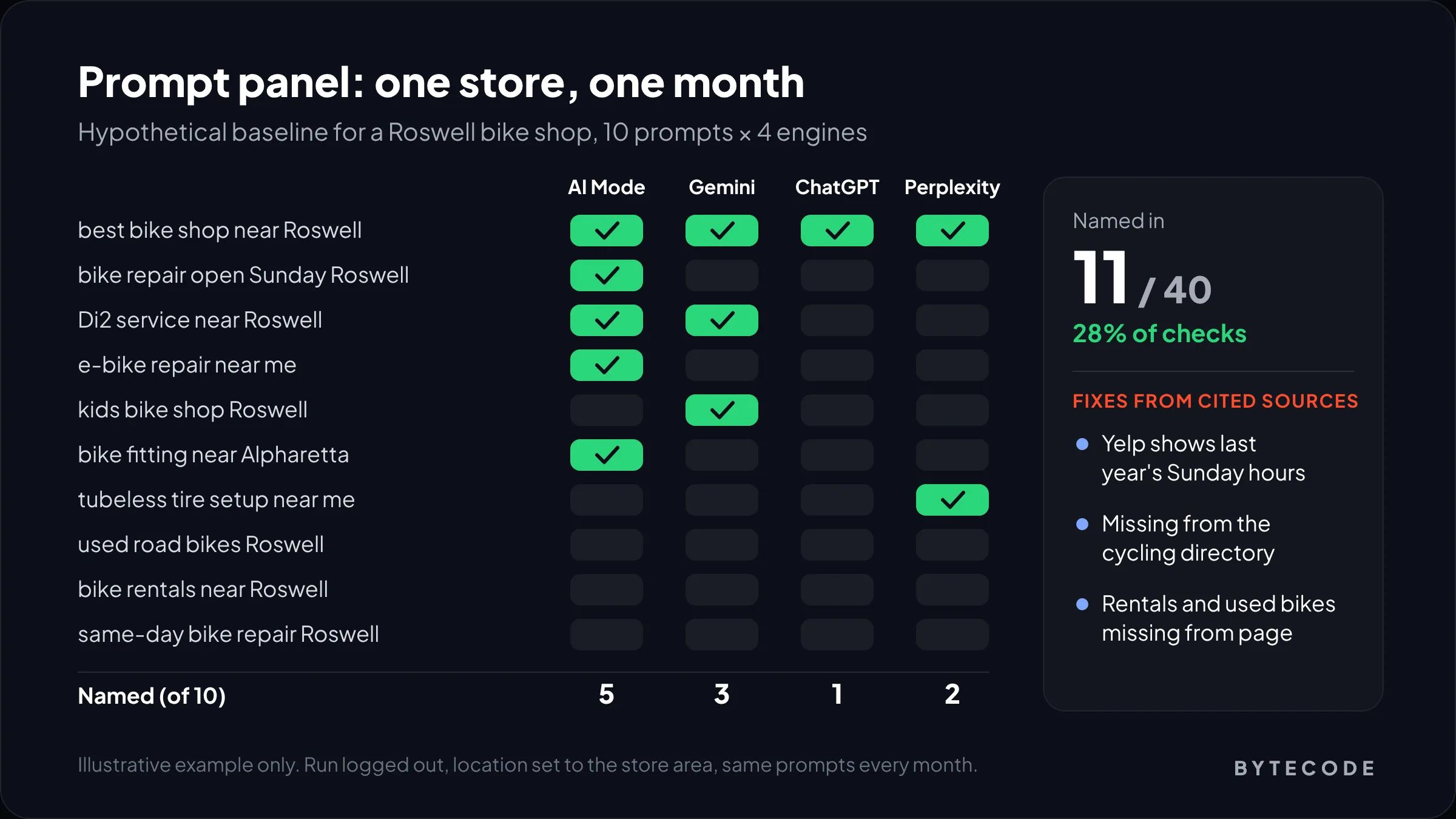
Here is a clearly hypothetical worked example. Say you run three bike shops north of Atlanta and test 10 prompts for the Roswell store on four engines: 40 checks. You are named in 11 of them, or 28%. AI Mode names you in 5 of 10, Gemini in 3, Perplexity in 2 and ChatGPT in 1. The cited sources explain why: Perplexity cites a Yelp listing with last year’s Sunday hours, and ChatGPT cites a cycling directory that doesn’t list the Roswell shop. That is a two-hour fix list, not a strategy deck.
Answers vary between users, so ignore a one-month swing of a check or two. Watch three-month trends and whether cited sources get more accurate.
Frequently asked questions
How do I get my business to show up in AI Overviews for near me searches?
Start with a complete, accurate Google Business Profile, a steady flow of detailed reviews, and a location page that answers common questions plainly. AI Overviews draw on Business Profile data, review sites and website content, and Google says a page only needs to be indexed and snippet-eligible. No special markup or file is required, but your details must agree everywhere.
Does ChatGPT use Google Business Profile data?
Not in the way Google’s own AI features do. Studies of ChatGPT’s local answers point to business websites, Foursquare-style listings and industry directories instead. Whitespark’s Darren Shaw scores Business Profile categories at zero for ChatGPT. That is why your website and third-party listings need the same care as your Google profile if you want ChatGPT to recommend you.
Do reviews affect AI search recommendations?
Yes, heavily. SOCi’s 2026 data shows recommended locations averaging 4.3 stars in ChatGPT and 4.2 in Perplexity, so a low rating usually keeps you off the shortlist entirely. Review text matters too, because AI answers explain their picks using details from reviews. Ask customers to mention the specific service they received, not just the star rating.
Does LocalBusiness schema help with AI search?
It helps machines read your details correctly, but it is not a ranking shortcut. Google says no special schema is needed to appear in AI Overviews or AI Mode, and that structured data should match the visible page. Add LocalBusiness markup with name, address, coordinates, hours and phone for each location, and keep it identical to your Business Profile.
How can I track whether AI tools recommend my business?
Run a fixed set of 10 to 15 customer-style prompts per location each month across AI Mode, Gemini, ChatGPT and Perplexity, and record whether you are named and which sources are cited. Add GA4 referral data from chatgpt.com and perplexity.ai, plus Business Profile Performance. Search Console includes AI feature traffic but does not report it separately.
Is local SEO still worth it in 2026 if people use AI instead of Google?
Yes, because AI engines are built on the same local data. Your Business Profile, reviews, listings and website feed AI answers directly. BrightLocal also found that 97% of AI users sometimes double-check recommendations against real reviews, so classic local profiles still decide whether the person who saw your name actually calls you.
What we’d do first
Most local SEO 2026 checklists stop at the Business Profile, which covers Google’s AI and leaves ChatGPT and Perplexity guessing. Our first 30 days would look like this:
- Week 1: run the prompt panel for every location and log every cited source. That is your baseline and fix list.
- Week 2: build one master location spreadsheet (name, address, phone, hours, categories, services, coordinates) and correct the Business Profile, Apple, Bing, Yelp and Foursquare listings against it.
- Week 3: rewrite each location page in the outline above, add LocalBusiness schema from the same data, and publish the FAQs customers really ask.
- Week 4: start a steady review request that asks about the job, and line up two or three local mentions per location for the next quarter.
Then rerun the panel monthly and judge the trend over a quarter. The work is unglamorous, and it is exactly what lets an engine write one confident sentence about you instead of the shop down the road.
If you would rather hand this off, our local SEO for AI search team runs the panel, cleans the data and builds the location pages, including on Shopify stores with physical retail.