On this page
- The best headless CMS options in one table
- Hosting model: SaaS or self-host
- Strapi vs Sanity: the comparison we get asked most
- Payload CMS: the developer’s pick, with conditions
- Contentful and the Contentful alternatives worth a look
- Editor experience: what your marketing team will feel
- Localization: where plans quietly cap you
- Pricing traps we check before anyone signs
- Worked example: year-one licence and hosting cost
- Which headless CMS fits which team
- Frequently asked questions
- What we’d do first
A content team picks a CMS from a feature grid, signs, and six months later learns the plan allows three languages. The fourth market now needs an enterprise contract. We see that story more often than any bad API.
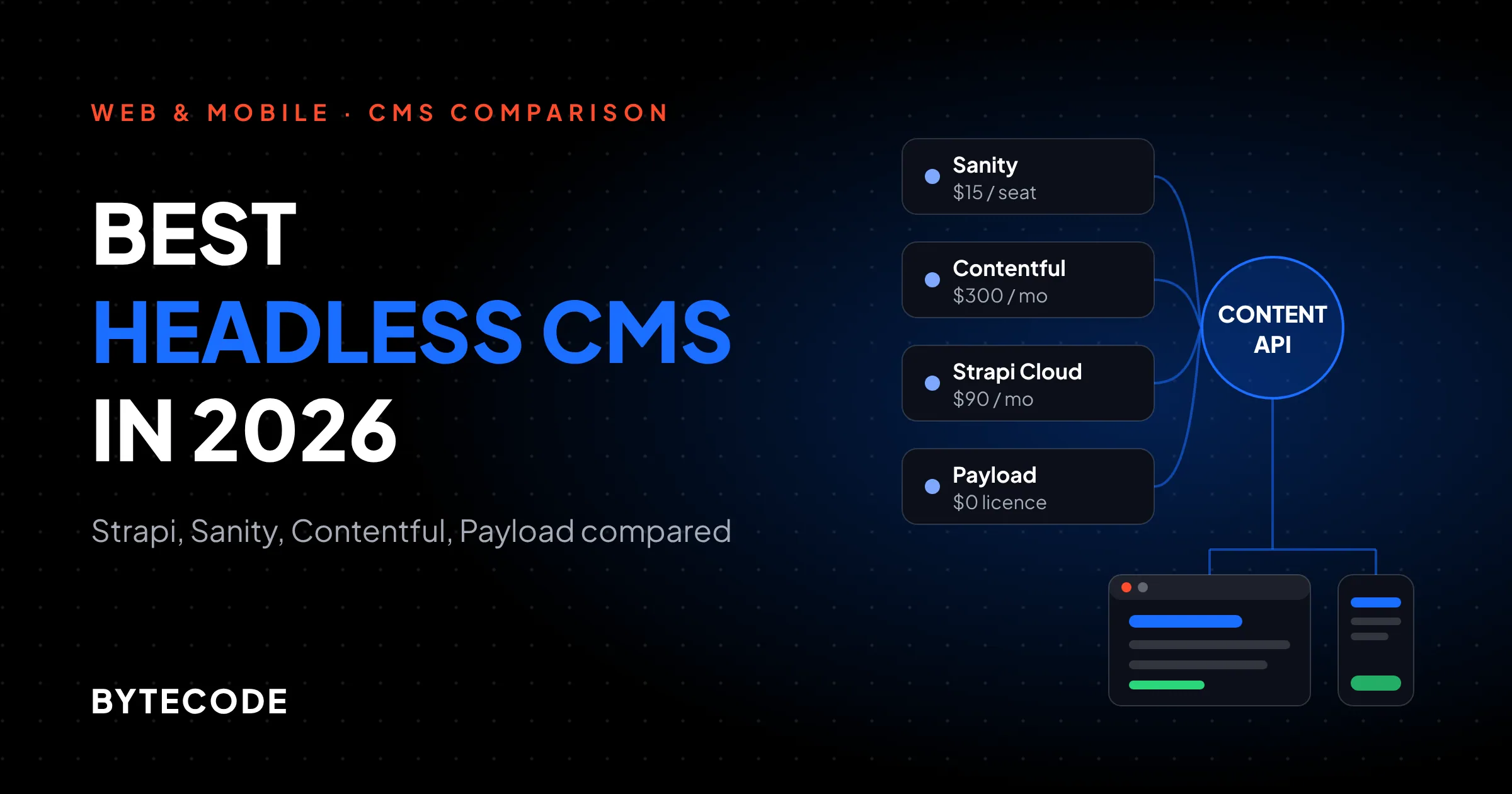
So here is our answer up front. The best headless CMS for most mid-sized teams in 2026 is Sanity if editors drive the work, and Payload if developers do. Strapi fits teams that want open source with a familiar admin panel and a paid cloud option. Contentful earns its price at enterprise scale, mostly when governance matters more than budget. Below are vendor prices we checked in November 2026, the locale caps hiding in each plan, and a worked year-one cost model.
Key takeaways
- Entry prices are close: Sanity Growth is $15 per seat a month, Strapi Cloud Pro is $90 a month, and Payload costs nothing to license. Contentful’s first paid plan, Lite, is $300 a month.
- Localization is the most common hidden ceiling. Contentful caps locales at 2 on Free and 3 on Lite. Sanity, Strapi and Payload list unlimited locales.
- Overage pricing differs by an order of magnitude. At 5 million API requests a month, Strapi Cloud Pro overage alone is $240, while Sanity’s CDN overage is $16.
- Self-hosting is not automatically cheaper. Once you price the ops hours, a self-hosted Payload or Strapi setup can cost more in year one than a SaaS plan.
The best headless CMS options in one table
If you only read one thing, read this table. It compares the four platforms on hosting model, the first paid tier and the limits that most often force an upgrade. All prices are USD, per month, from the vendor pages linked in each section below.
| Sanity | Contentful | Strapi | Payload | |
|---|---|---|---|---|
| Hosting model | SaaS content store; Studio is code you deploy | SaaS only | Self-host (open source) or Strapi Cloud | Self-host, runs inside your Next.js app |
| Free tier | Up to 20 seats, 10k documents, public datasets only | 10 users, 2 locales, testing and learning only | Community edition, unlimited seats | Full product, MIT licence |
| First paid tier | Growth: $15 per seat | Lite: $300 | Cloud Pro: $90 (hosting); CMS Growth: $45 incl. 3 seats | Enterprise: quote only |
| Locales | Unlimited on every plan | 2 Free, 3 Lite, custom above | Unlimited | Unlimited |
| API included (paid entry) | 1M CDN + 250k API requests | 1M API calls | 1M requests (Cloud Pro) | Your servers, your limits |
| Overage | $1 per 250k CDN requests | About $5 per 1M calls | $1.50 per 25k requests | Infrastructure cost only |
| SSO | Enterprise only | Check with sales | Growth add-on ($150 + $50/user) or Enterprise | Enterprise |
| Fits best | Editor-led teams, structured content | Large orgs, many spaces, governance | Teams wanting open source plus a GUI | TypeScript teams already on Next.js |
Still deciding whether to go headless at all? Start with our headless CMS vs WordPress comparison.
Hosting model: SaaS or self-host
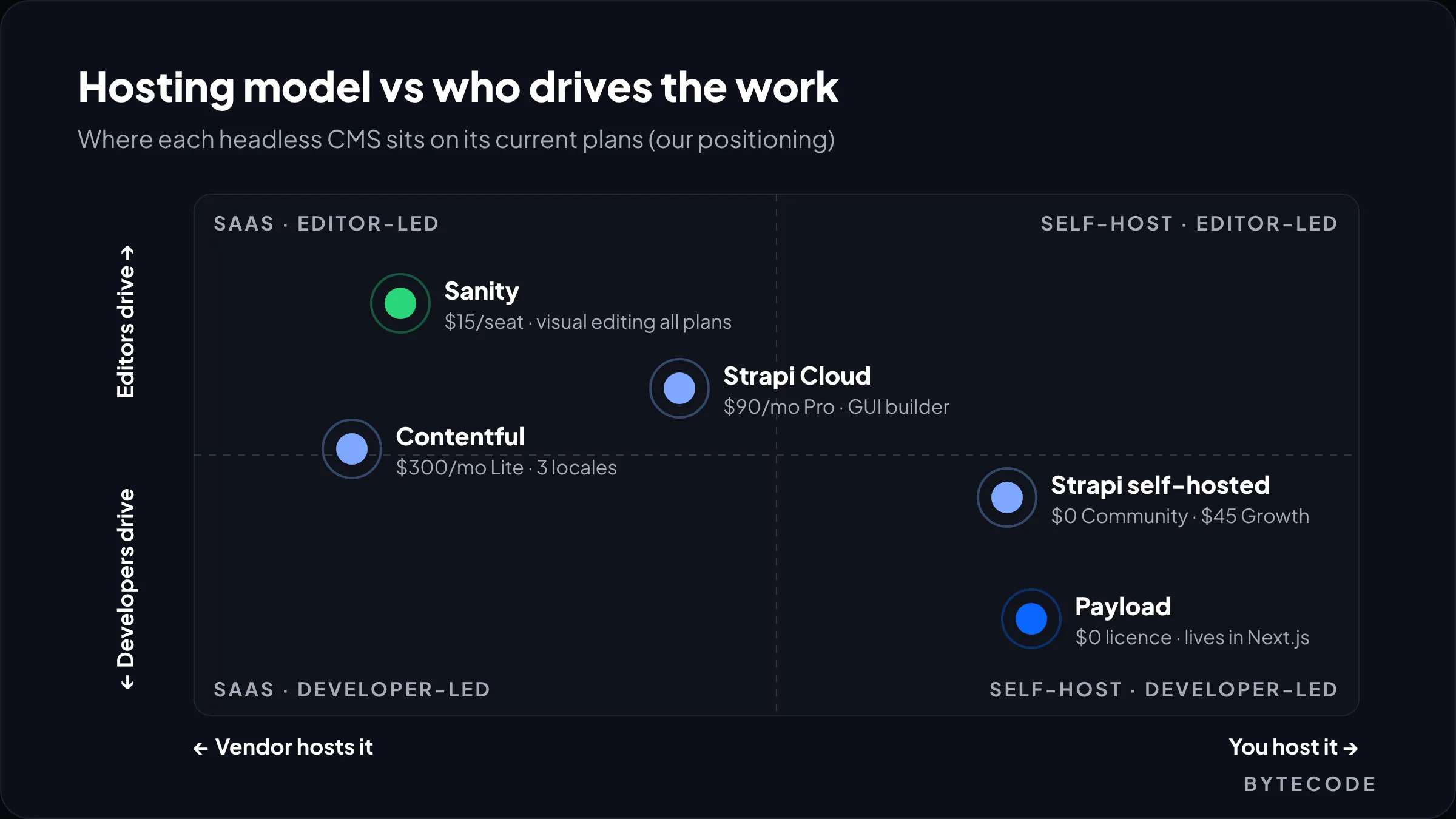
SaaS (Sanity, Contentful, Strapi Cloud) means someone else runs the database and backups, and you pay per seat or usage. Self-hosting (Strapi, Payload) means a free or cheap licence and a server your team patches. The real question is whether someone on your team is already on call.
Sanity sits in between. The content store is hosted, but Sanity Studio (the editing UI) is a React app configured in code, so your developers own its schema and deployments. That is why “we bought Sanity” never means “we’re done.”
Strapi gives you the clearest choice of the four. You can run the open-source Community edition yourself for free, or pay Strapi Cloud $35, $90 or $450 a month for Starter, Pro or Business. The CMS feature tiers live on a separate Strapi CMS pricing page, so hosting and features are priced separately.
Payload installs into a Next.js project, so the admin panel and the website can ship as one codebase on one host. If you already deploy Next.js, that removes a whole service. If not, it adds a framework to learn first (see our React vs Next.js guide).
Watch out: Strapi Cloud Starter sleeps when idle and includes no backups, per Strapi’s own plan table. For anything editors rely on, Pro at $90 (weekly backups, always on) is the real entry point.
Strapi vs Sanity: the comparison we get asked most
Pick Sanity when the content model keeps changing and editors need live preview on any plan. Pick Strapi when you want data in your own database, a click-to-build admin and an easy exit. Both are good. They fail differently.
How content modelling feels
In Strapi, someone builds content types in the Content-type Builder, which writes schema files you commit. In Sanity, every schema is a TypeScript file from day one. No GUI builder slows the first week and speeds up every month after, because schema changes go through code review.
What the money buys
Sanity’s pricing page lists Growth at $15 per seat a month for up to 50 seats, with 25,000 documents, 1 million API CDN requests and 250,000 API requests a month. Viewers are free on every plan, so stakeholders who only review cost nothing.
Strapi’s self-hosted Growth tier is $45 a month with 3 seats included, then $15 per extra user. It adds Live Preview, unlimited Releases and 14 days of content history. Review workflows and audit logs stay on Enterprise, which has no public price.
Where each one bites
- Sanity: Growth includes 2 datasets. A third, which teams often want for a proper staging copy, is an add-on at $999 a month. We usually structure staging around the second dataset instead.
- Sanity: Content Releases (bundling many changes for one launch) is an Enterprise add-on on the plan comparison page. Growth does get scheduled drafts, comments and tasks.
- Strapi: if you need SSO on Growth, the add-on is $150 a month plus $50 per user. For a 10-person team that is $650 a month just for login.
- Strapi: self-hosting means major version upgrades land on your backlog, not the vendor’s.
Our default: a marketing site with five or more editors gets Sanity. An app backend where the CMS is one part of a bigger system gets Strapi or Payload.
Payload CMS: the developer’s pick, with conditions
Payload CMS is the strongest option when your developers write TypeScript and already deploy Next.js. The config is code, the admin is generated from it, and there is no licence fee: the core is MIT licensed. The conditions are about who runs it, not what it can do.
What we like in practice: access control is a function you write per collection or field, so “regional editors only see their market” is a few lines. Hooks run on every change, which makes pushing content to a search index easy. Localization is per field: mark it localized: true and Payload stores every language inside that field, with fallback on by default.
What we warn clients about:
- There is no self-serve hosted plan to buy. Enterprise is quote only. Budget for your own hosting, database and backups from day one.
- Your editors get a developer’s admin. It is clean and fast, but visual page-building needs work your team builds on top.
- Schema changes are migrations. Payload’s localization docs warn that switching an existing field to or from localized changes its data shape, and existing data in that field will be lost without a migration.
That last point applies to any schema-in-code CMS. Plan localization before the first entry.
From our team: on headless Shopify builds, Payload is often our first suggestion when the storefront is already Next.js. Products stay in Shopify, editorial pages live in Payload, and one repo deploys both. Fewer moving parts than a separate SaaS CMS.
Contentful and the Contentful alternatives worth a look
Contentful is a solid enterprise platform priced for enterprises: Lite starts at $300 a month and anything bigger is a custom contract. Contentful alternatives make sense when your team is under 20 people or needs more than three languages without an enterprise deal.
The numbers, from Contentful’s pricing page: Free gives 10 users, 2 roles, 2 locales, 100,000 API calls and 50 GB of CDN bandwidth a month, with a Starter Space of 25 content types, 2 environments and 10,000 records. Lite raises that to 20 users, 3 roles, 3 locales, 1 million API calls and 100 GB. An extra Lite Space with 50 content types, four environments and 50,000 records is an $850 a month add-on. The site footer now reads Salesforce, which owns Contentful. Worth weighing if you are not a Salesforce shop.
The Contentful usage limits page adds two details that belong in any contract review. Free plan overages are simply not allowed, and the Free plan is not for commercial use. On Lite, overage runs about $5 per extra million API calls and $0.15 per extra GB of bandwidth, with no cap.
Where we would look instead:
- Sanity, for similar structured content at a per-seat price.
- Payload, when cost is the reason and your team can run servers.
- Storyblok, when marketers want a visual page editor above all (priced in our WordPress comparison).
Contentful still wins for large organisations with many brands and a procurement team that wants a big vendor with SLAs. If that is you, negotiate locales and environments into the contract up front.
Editor experience: what your marketing team will feel
Most editors judge a CMS on one thing first: can they see the page before it goes live? Sanity gives visual editing on every plan. Strapi puts Live Preview on its paid Growth tier. On Payload and Contentful, it depends on the build.
Sanity’s comparison page lists visual editing and the Presentation tool on all three plans: an editor clicks a heading on the real page and lands on the matching field. That does more for adoption than any training session.
History differs quietly. Sanity keeps Review Changes for 3 days on Free, 90 on Growth and 365 on Enterprise. Strapi Growth keeps 14 days; Community keeps none. If legal asks what a page said last month, 14 days will not answer it.
What we put in every editor handover
- A preview link tested on drafts, not just published content
- 10 to 15 approved page blocks, not 40
- Roles that match the team: writer, editor, publisher, market owner
- A webhook that revalidates the front end on publish, so “I hit publish and nothing changed” never reaches Slack
None of this ships out of the box. It is build work, and where our CMS development team spends most of the first sprint.
Localization: where plans quietly cap you
Sanity, Strapi and Payload all allow unlimited locales. Contentful allows 2 on Free and 3 on Lite, with more only on a custom plan. That single row is the most common reason we see teams outgrow a plan in year one.
Unlimited still has catches:
- Sanity counts unique attributes per dataset: 2,000 on Free and 10,000 on Growth. Field-level translation multiplies attribute paths by language, so a rich schema in eight languages can hit it first.
- Sanity document-level translation (one document per language) multiplies documents instead. 6,000 pages in four languages is 24,000 documents against Growth’s 25,000.
- Strapi only lets you pick from its predefined list of 500+ locale codes, and its internationalization docs warn that deleting a locale permanently deletes its content across every content type. Back up before you tidy up.
- Payload lets you set a fallback locale per language (Swiss German falling back to German, then English), which is the cleanest fallback setup of the four.

Decide field-level or document-level translation before modelling content. Changing it later means migrating data on every platform.
Pricing traps we check before anyone signs
The headline price is rarely what you pay. Overage rates and add-ons for staging or SSO move the real bill far more. This is the list we run through on every headless CMS comparison for a client.
API overage rates
Take a site whose front end makes 5 million CMS requests a month (a busy site with weak caching). On the entry paid plans, overage alone is $16 on Sanity (4 million extra CDN requests at $1 per 250,000), about $20 on Contentful Lite, and $240 on Strapi Cloud Pro (160 blocks of 25,000 at $1.50). Same traffic, a 15-fold gap in overage.

The fix is usually caching, not a bigger plan. A static or ISR front end should hit the CMS on publish, not on every page view.
Staging and environments
A third Sanity dataset is $999 a month. An extra Strapi Cloud environment is $60 a month on Pro and $300 on Business, and Starter cannot add one. Contentful’s Starter Space has 2 environments. Price your release process, not just production.
SSO and governance
SSO and custom roles are Enterprise-only on Sanity; SSO is a paid add-on on Strapi Growth. If IT will insist on SAML, get the enterprise quote early.
Free tiers that are not production tiers
Contentful Free is for testing only. Sanity Free has public datasets only, so anyone with the project ID can read published content. Strapi Cloud Starter sleeps when idle. Fine for prototypes, wrong for launch.
Want a second pair of eyes on a CMS quote?
Send us your page count, languages, editor headcount and traffic, and we will price all four platforms against your real usage.
Get a CMS cost check
Worked example: year-one licence and hosting cost
Licence fees are a small part of total cost, and self-hosting only wins if you already pay for ops. A hypothetical: say you run a B2B brand site with 8 editors, 3 languages, about 6,000 entries and 1.2 million CMS API requests a month after caching.
| Option | Monthly licence and usage | Hosting (our assumption) | Ops time (our assumption) | Year one |
|---|---|---|---|---|
| Sanity Growth | 8 seats × $15 + $1 CDN overage = $121 | Included | 1 h/mo at $60 | $2,172 |
| Contentful Lite | $300 + about $5 overage = $305 | Included | 1 h/mo at $60 | $4,380 |
| Strapi Cloud Pro | $90 + $12 overage = $102 | Included | 1 h/mo at $60 | $1,944 |
| Strapi self-hosted Growth | $45 + 5 extra seats × $15 = $120 | $80/mo | 4 h/mo at $60 | $5,280 |
| Payload self-hosted | $0 | $80/mo | 4 h/mo at $60 | $3,840 |
The $80 hosting (app server, managed Postgres, storage, backups) and the ops hours are our planning figures, not vendor prices.
Strapi Cloud Pro is cheapest here, but Live Preview and Releases sit on the CMS Growth tier, so confirm what your Cloud project includes. Contentful costs about double Sanity, and a fourth language pushes it off Lite. Payload’s free licence lands mid-table once someone has to run it.
Now compare that with the build, which is typically weeks of engineering. The licence gap between the cheapest and dearest option above is about $3,700 a year. Pick the platform that makes the build and three years of editing easier.
Which headless CMS fits which team
Match the platform to whoever owns the content model after launch. We use this table in discovery calls.
| Your situation | Our pick | Why |
|---|---|---|
| Marketing team of 5 to 30, developers on call, several languages | Sanity | Visual editing on every plan, unlimited locales, per-seat pricing, free viewers |
| Next.js product team, TypeScript everywhere, own infrastructure | Payload | One codebase, no licence, access control and hooks in code |
| Startup that wants open source but a GUI for content types | Strapi Cloud Pro | Low entry price, managed hosting, an exit to self-hosting later |
| Agency or in-house team that must keep data on its own servers | Strapi or Payload, self-hosted | Data residency and full control over the database |
| Enterprise with many brands, Salesforce stack, procurement rules | Contentful | Spaces, governance and a large vendor with contracts and SLAs |
| One marketing site, small team, editors who build pages alone | Possibly none of these | A classic CMS may be cheaper; see the WordPress comparison |
What would we skip? Choosing a platform because a developer liked it on a side project. Editor experience and plan limits matter more than API style.
Self-hosting also means owning CI, backups and monitoring; our DevOps guide covers the minimum setup.
Frequently asked questions
What is the best headless CMS in 2026?
There is no single best headless CMS; it depends on who runs it. Sanity suits editor-led teams thanks to visual editing on every plan and $15 per seat pricing. Payload suits TypeScript teams on Next.js who can self-host. Strapi suits teams wanting open source with a GUI. Contentful suits large enterprises with governance needs and budget for custom contracts.
Is Strapi better than Sanity?
Strapi is better if you want your content in your own database and the option to self-host for free. Sanity is better if editors need live visual preview and a hosted backend without running servers. Strapi Cloud Pro costs $90 a month, while Sanity Growth costs $15 per seat, so team size often decides which is cheaper.
Is Payload CMS free?
Yes, Payload CMS is free and MIT licensed, including for commercial projects. You pay for your own hosting, database, storage and backups instead. Payload sells an Enterprise plan with support and extra features, but it has no public price. For most small and mid-sized projects, the open-source version is what teams run in production.
How much does Contentful cost per month?
Contentful’s Lite plan costs $300 a month and includes 20 users, 3 locales and 1 million API calls. The Free plan is limited to testing and learning, not commercial use. Larger needs move to custom-priced plans, and an extra Lite Space with 50,000 records and four environments is an $850 a month add-on.
What is a good alternative to Contentful?
Sanity is the closest alternative to Contentful for structured content and governance, at $15 per seat a month on Growth with unlimited locales. Payload and Strapi are better alternatives if cost is the main reason to leave and your team can host its own CMS. Storyblok suits teams that want a visual page editor first.
Should I self-host my headless CMS?
Self-host only if you already have someone responsible for servers, backups and upgrades. The licence savings are real but small, often a few thousand dollars a year. Once you add hosting and ops hours, a self-hosted Strapi or Payload setup can cost more in year one than a SaaS plan like Sanity Growth or Strapi Cloud Pro.
What we’d do first
Before you book a single demo, write down four numbers: editor seats, languages (now and in two years), entries, and monthly page views. Then check each platform’s plan page against those numbers, especially the locale row, the overage rates and the staging setup. Most shortlists drop from four names to two in an afternoon.
Then build one real page type on each finalist: three blocks, a preview link, one translation. Give it to an editor for an hour and watch where they get stuck. That hour beats any feature grid, including ours.
We have built content platforms and storefronts for brands like Delsey, EcoFlow and Kerbholz, and we work across all four of these systems. If you want help running that test or modelling your costs, our headless CMS solutions team can scope it with you.