On this page
- When you have to register for GST/HST
- GST, HST, PST and QST rates by province
- PST and QST: the registrations people miss
- How to set up GST/HST, PST and QST in Shopify
- Worked example: one Shopify Canada store, five provinces
- Quebec’s French rules for Shopify stores
- Building a bilingual Shopify Canada store with Markets
- Payments and shipping for Shopify Canada stores
- Frequently asked questions
- What we’d do first
Running a Shopify Canada store means three jobs: registering for GST/HST once your taxable sales pass $30,000, deciding which provincial taxes (PST, RST, QST) you also owe, and giving Quebec shoppers a French store of the same quality as your English one. Shopify will do the arithmetic for you. It will not register you, pick your provinces or translate your store.
Most Canadian stores we review get the first job right and the other two wrong: GST/HST switched on, nobody checking whether BC or Quebec expect their own registration, and a machine-translated French theme with every app widget still in English. Below is how we set up Shopify Canada stores in late 2026, with rates re-checked against the Canada Revenue Agency.
Watch out: this is a practical setup guide, not tax or legal advice. Rates and thresholds below were checked in November 2026 against CRA, Shopify Help Center and Quebec sources linked inline. Confirm your own obligations with an accountant or the tax authorities before you file.
Key takeaways
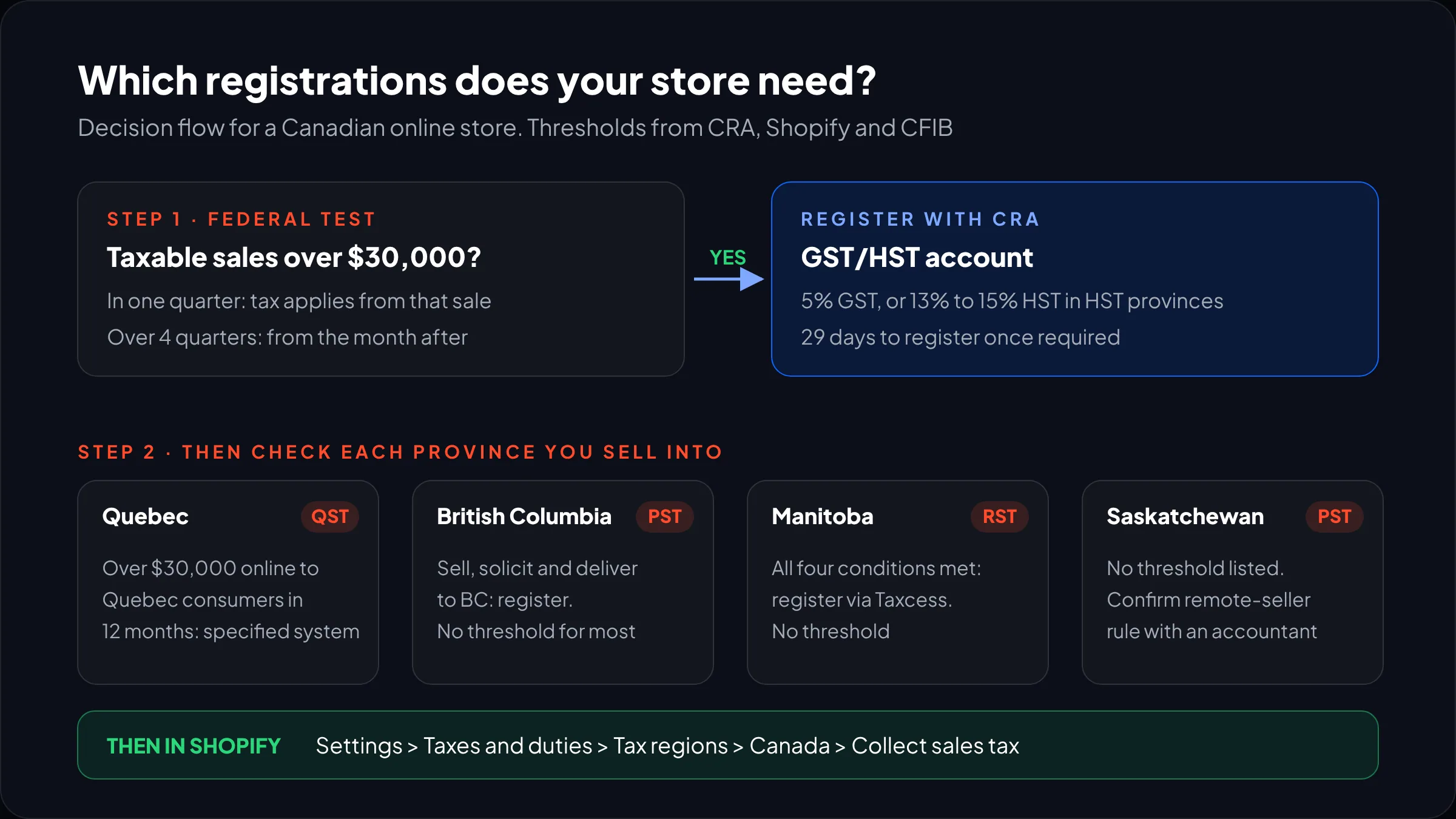
- GST/HST registration is generally required once taxable sales pass $30,000 over four consecutive calendar quarters, or in a single quarter. In a single quarter, tax applies from the sale that crosses the line.
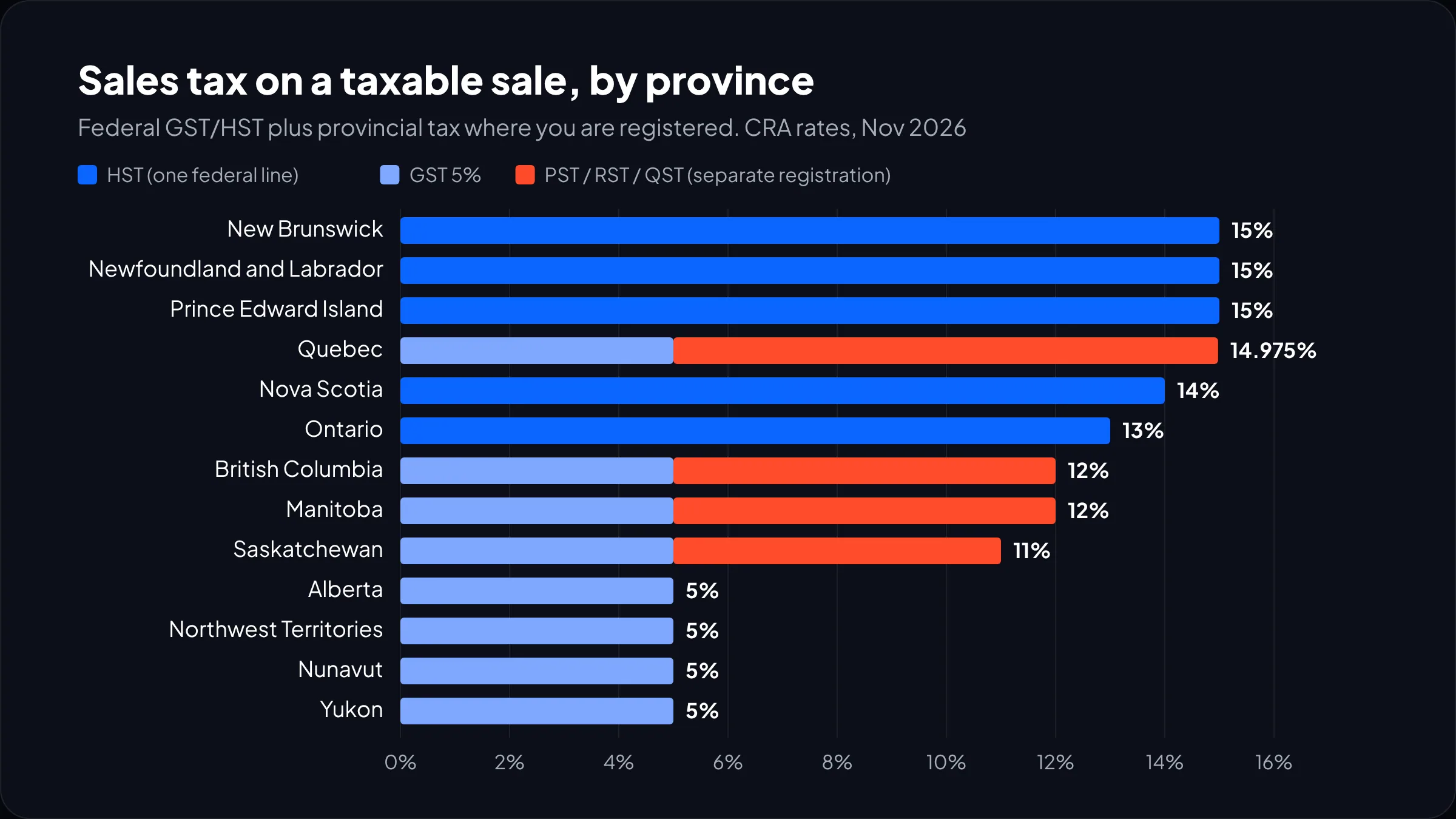
- Rates run from 5% (GST only) to 15% (HST in New Brunswick, Newfoundland and Labrador, and PEI). Nova Scotia dropped to 14% on April 1, 2025.
- BC PST and Manitoba RST have no minimum threshold for most out-of-province sellers who meet the conditions. Quebec’s specified QST system kicks in above $30,000 of online sales to Quebec consumers.
- Stores set up after May 13, 2026 cannot use Shopify’s Basic Tax in Canada. Shopify Tax is free on the first $100,000 CAD of lifetime sales, then charges 0.25%.
- Quebec expects websites in French of comparable quality. Fines for enterprises run $3,000 to $30,000 per offence and double on a repeat.
When you have to register for GST/HST
You must register for GST/HST once your worldwide taxable sales exceed $30,000, measured either within a single calendar quarter or over the last four consecutive quarters. Below that you are a “small supplier” and registration is optional. The details matter more than the number, so here is how the CRA’s registration rules actually play out for an online store.
- Cross $30,000 in one quarter (January, April, July or October start) and you stop being a small supplier on the sale that takes you over. GST/HST applies to that sale.
- Cross it gradually over four quarters, with no single quarter above $30,000, and you lose the status at the end of the month after the quarter where you crossed. You charge tax from your first sale after that point.
- Revenue means gross. Taxable sales before expenses, zero-rated included, plus associated businesses.
- You get 29 days from the effective date to register once you are required to.
The single-quarter rule is the one that bites. A store doing $8,000 a month can do $35,000 in a Black Friday quarter and owe tax from the order that crossed the line, while checkout still charges nothing.
Should you register early? Usually. Voluntary registration lets you claim input tax credits on your plan, apps and agency invoices. The cost is that your prices now carry tax. If you expect to pass $30,000 within a year, register at launch.
Stores based outside Canada have a different test. Shopify’s Canadian taxes reference says a non-Canadian store that ships taxable orders to Canadian customers from a Canadian warehouse generally needs a GST/HST account once those sales pass $30,000 over the past twelve months.
GST, HST, PST and QST rates by province
Canada has one federal 5% GST, five provinces that fold it into a single HST, and four provinces that charge a separate provincial tax on top of GST. The table uses the rates on the CRA’s GST/HST rates page, with the provincial tax names from Shopify’s reference.
| Province or territory | Federal (GST/HST) | Provincial tax | Combined on a taxable sale | Who collects the provincial part |
|---|---|---|---|---|
| Alberta | 5% GST | None | 5% | n/a |
| British Columbia | 5% GST | 7% PST | 12% | BC Ministry of Finance |
| Manitoba | 5% GST | 7% RST | 12% | Manitoba Finance |
| New Brunswick | 15% HST | Included | 15% | CRA |
| Newfoundland and Labrador | 15% HST | Included | 15% | CRA |
| Northwest Territories | 5% GST | None | 5% | n/a |
| Nova Scotia | 14% HST (since April 1, 2025) | Included | 14% | CRA |
| Nunavut | 5% GST | None | 5% | n/a |
| Ontario | 13% HST | Included | 13% | CRA |
| Prince Edward Island | 15% HST | Included | 15% | CRA |
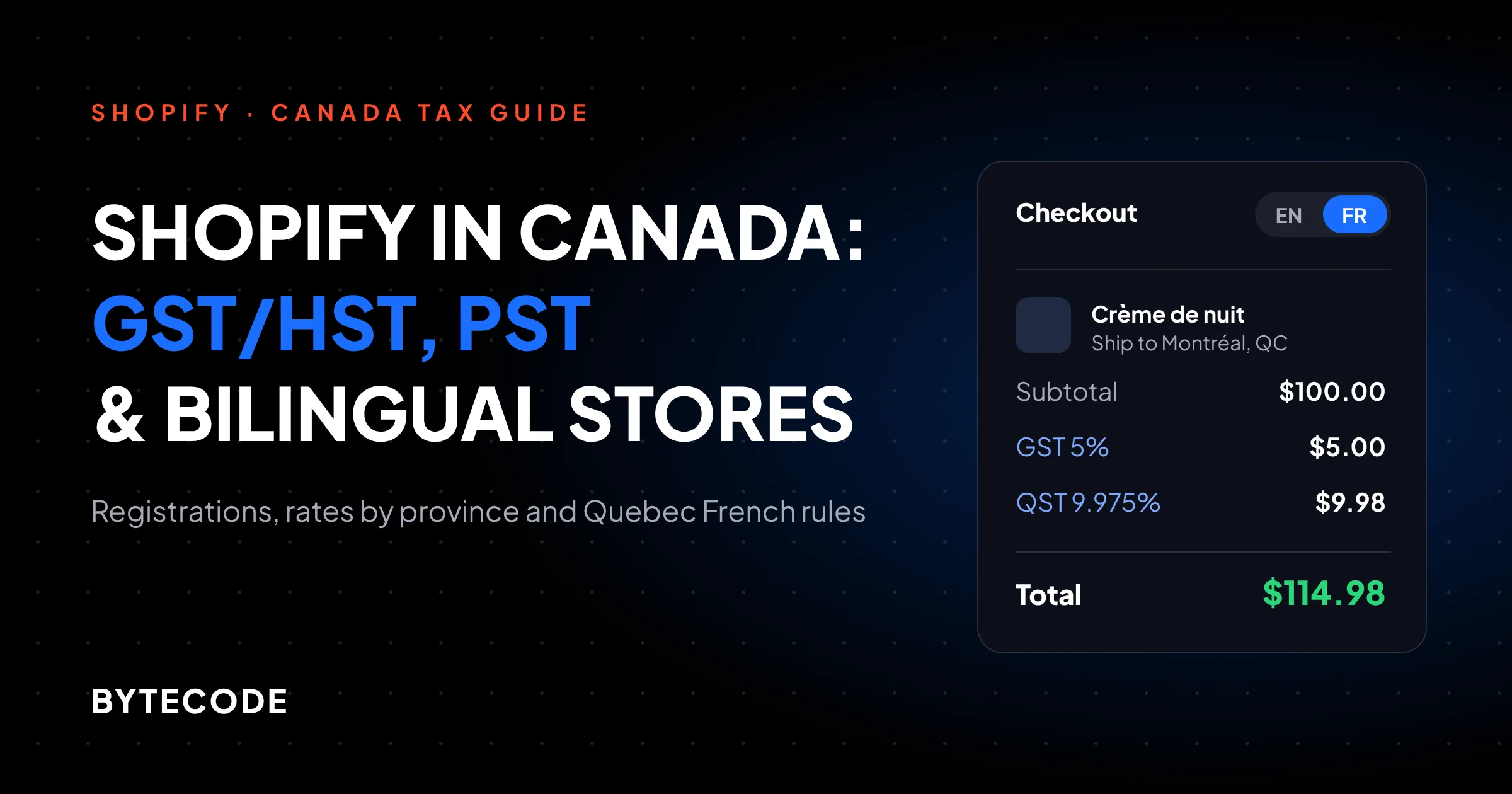
| Quebec | 5% GST | 9.975% QST | 14.975% | Revenu Québec |
| Saskatchewan | 5% GST | 6% PST | 11% | Saskatchewan Ministry of Finance |
| Yukon | 5% GST | None | 5% | n/a |
The “combined” column only applies if you are registered for that province’s tax. An Ontario store with only a GST/HST number charges a BC customer 5%, not 12%.
PST and QST: the registrations people miss
Out-of-province sellers get caught here because the triggers differ from the federal rule. BC and Manitoba have no minimum for most remote sellers who meet their conditions. Quebec has its own $30,000 test for online sales.
British Columbia PST
According to Shopify’s reference, a seller outside BC must register for PST if it regularly sells taxable goods to BC customers, accepts orders from BC, delivers to BC and solicits BC buyers. Storing goods in BC triggers registration too. The $10,000 small-seller threshold only helps BC residents without a commercial location in the province. In practice, if you run Meta ads targeted at Vancouver and ship there, assume you need a BC PST number.
Manitoba RST
Same idea: Shopify lists four conditions (soliciting Manitoba sales, accepting Manitoba orders, goods used in Manitoba, delivery to Manitoba) and no threshold. Registration runs through Manitoba’s Taxcess portal.
Saskatchewan PST also has no threshold, per the same page, but Shopify gives no separate out-of-province test. Ask your accountant before enabling it.
Quebec QST
Quebec’s specified QST system has applied since September 1, 2019 to businesses with no physical presence in Quebec. The CFIB’s summary of the rule puts the trigger at more than $30,000 of taxable online sales to Quebec consumers over 12 months, judged by signals like billing address and IP location. Businesses based in Quebec, or storing goods there, use the general system instead.
From our team: when we take over a Canadian store, the first report we pull is sales by shipping province for the last four quarters (an Analytics > Reports sales report broken down by shipping region). It takes five minutes and usually answers the “do we need BC or Quebec” question before anyone opens a tax portal.
How to set up GST/HST, PST and QST in Shopify
In Shopify, you add each registration under Settings > Taxes and duties > Tax regions > Canada, then choose Collect sales tax, pick the region and enter the tax number. Shopify only charges a province’s tax once that registration exists.
- Register with the agencies first. CRA for GST/HST, plus BC, Manitoba, Saskatchewan or Revenu Québec as needed. Shopify cannot do this for you.
- Add the federal registration. In Tax regions > Canada > Sales tax, click Collect sales tax, select Canada and enter your GST/HST number. If your number is pending, Shopify lets you leave it blank and fill it in later.
- Add each provincial registration the same way: British Columbia, Manitoba, Saskatchewan, Quebec. Each one switches on that province’s provincial line at checkout.
- Decide on tax-inclusive pricing under Settings > Taxes and duties > Tax calculations. Most Canadian stores show prices before tax, as shoppers expect.
- Handle the exceptions. Use product categories (with Shopify Tax) or manual overrides (Tax rates and exemptions > Add override) for items with lower or zero rates. Customer exemptions, such as resellers, go on the customer profile.
- Test four checkouts before you call it done: an Ontario, a BC, a Quebec and an Alberta address. Check the tax lines on the order, not just the cart total.
Shopify Tax or manual settings?
For a store created after May 13, 2026, the choice is Shopify Tax or manual rates, because Shopify’s reference says Basic Tax is only available to stores already collecting Canadian tax before that date. Shopify Tax in Canada handles GST, HST, PST, QST and RST by buyer location, splits shipping tax across mixed carts and tracks your sales against registration thresholds. It is free on your first $100,000 CAD of lifetime sales, then charges 0.25% per order (0.15% on Plus) for stores created on or after May 13, 2026 with under $25M USD in annual sales.
Our view: use Shopify Tax unless you have a reason not to. Hypothetically, a store doing $400,000 CAD a year, past its free allowance, pays about $1,000 a year in fees, less than an accountant’s afternoon fixing miscoded products. The exception is a store already running tax through an ERP, where you want one system calculating, not two. Our guide to Shopify ERP integration covers that case.
Watch out: Shopify Tax’s liability alerts only count Shopify sales. Amazon, wholesale invoices and market stalls all count toward the CRA’s $30,000, so add them yourself.
Tax on shipping
Shipping is usually taxable, with provincial twists. Per Shopify’s reference, HST provinces tax domestic shipping, BC taxes it when the goods are taxable, and Manitoba and Saskatchewan tax it when delivery starts outside the province. Shopify Tax handles this. With manual settings, check Shipping overrides.
Worked example: one Shopify Canada store, five provinces
Here is a hypothetical Toronto skincare brand to show how the rules combine. It sells only on Shopify, ships from Mississauga, and everything is fully taxable. Last 12 months: $420,000 CAD in sales, split Ontario $190,000, Quebec $85,000, BC $70,000, Alberta $45,000, and $30,000 spread across the other provinces and territories.
| Registration | Needed? | Why (in this example) | Tax on a $100 order |
|---|---|---|---|
| GST/HST (CRA) | Yes | Far above $30,000 in a single quarter | ON $13, AB $5, NS $14 |
| QST (Revenu Québec, specified system) | Yes | $85,000 of online sales to Quebec consumers, above $30,000 in 12 months | QC $5 GST + $9.98 QST |
| BC PST | Likely yes | Targets BC with ads, ships to BC, no threshold for out-of-province sellers | BC $5 GST + $7 PST |
| Manitoba RST | Check | Small volume, but no threshold if all four conditions are met | MB $5 GST (+ $7 RST if registered) |
| Saskatchewan PST | Check | No threshold per Shopify; confirm the remote-seller rule with an accountant | SK $5 GST (+ $6 PST if registered) |
The interesting line is Quebec. This brand needs a QST registration and, as the next section shows, a properly translated store. Miss QST and every Quebec order is under-taxed by about 10%: roughly $8,500 a year the business owes from its own margin.
For multi-province work like this, a shopify development agency earns its fee less on the tax screen (that part takes an hour) and more on the translation, app audit and checkout tests that come after it.
Launching or cleaning up a Canadian Shopify store?
Send us your store URL and a sales-by-province export, and we will tell you which registrations and French fixes to look at first.
Book a Canada store review
Quebec’s French rules for Shopify stores
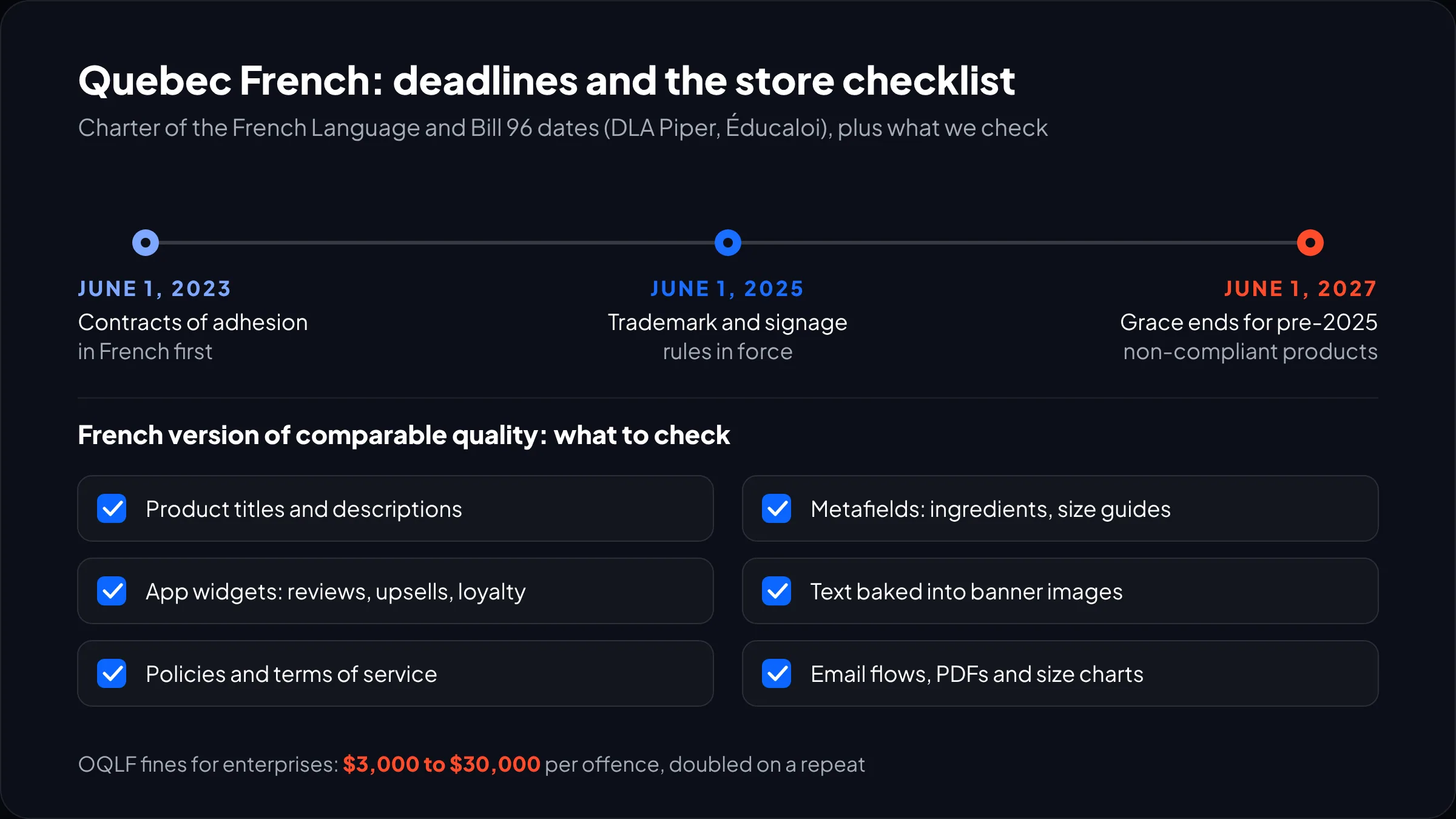
If you do business in Quebec, your website must be available in French, and the French version must be of comparable quality to any other language you offer. That is Éducaloi’s reading of the Charter of the French Language, which also covers catalogues and other commercial documents. The OQLF can order a fix by a deadline, and fines for violations after June 2022 run $3,000 to $30,000, doubling for a second offence.
Bill 96 (now Law 14) tightened several rules that touch an online store. The June 1, 2025 changes, summarized in DLA Piper’s overview, include:
- Trademarks on products: a recognized trademark can stay in English only if no French version is on the federal Trademarks Act register. Generic terms and descriptions next to it (think “Hydrating Night Cream”) must appear in French on the product or something permanently attached to it.
- A grace period: non-compliant products made before June 1, 2025 can be sold until June 1, 2027, provided no French version of the trademark was registered as of June 26, 2024.
- Signs and advertising: other languages are allowed only if French is “markedly predominant”, which for public signs means French text at least twice the size of the other language.
- Contracts of adhesion (your terms of service, for example) must be drawn up in French and presented in French first. This has applied since June 1, 2023.
Does this reach a Calgary store shipping to Montreal? DLA Piper’s summary does not settle that, and we are not lawyers. Our rule is commercial: once Quebec is a real share of revenue, translate properly. Shoppers notice, and the legal risk shrinks as a side effect.
What “comparable quality” means on a Shopify theme
It is not “the theme strings are translated”. On most bilingual stores we audit, the gaps sit in the same places:
- Product titles and descriptions translated, but metafield content (ingredients, size guides, care instructions) still English only.
- App blocks for reviews, bundles, upsells and loyalty showing English labels, because the app has its own translation settings outside the theme.
- Text baked into banner images. Translating the alt text does not translate the picture.
- Policy pages, the terms of service and the returns page left in English, which is exactly where the contract-of-adhesion rule bites.
- Klaviyo or Shopify Email flows that only exist in English, so a French shopper gets an English abandoned-cart email.
- Customer-facing PDFs and size charts.
Building a bilingual Shopify Canada store with Markets
Run English and French as two languages in one store, not as two stores. Add French under Settings > Languages, translate content with Shopify’s free Translate & Adapt app or a paid tool such as Weglot or Langify, and publish French to your Canada market in Settings > Markets. Shopify serves French on a subfolder (for example /fr) and adds the hreflang tags for you.
Two stores double your apps and tax setup, and every product update happens twice. We only split when the Quebec business has its own catalogue, pricing and team, which is rare below Plus. If you also sell to the US or Europe, our Shopify Markets guide covers how currencies, domains and duties fit around the Canada market.
Machine translation is a fine first draft, not a finished French store. Budget for a Quebec French editor to review product copy, navigation, policies and the top email flows. “Courriel” versus “email” is small, and Quebec shoppers notice.
One thing we would skip: auto-redirecting by IP to French. Show a language switcher and remember the choice. Bilingual shoppers in Ottawa and Montreal hate being forced.
Payments and shipping for Shopify Canada stores
Shopify Payments pays out in CAD. On Shopify’s Canadian pricing page in November 2026, Basic, Grow and Advanced cost $37, $99 and $389 CAD a month on yearly billing, Plus starts at $3,400, and online card rates are 2.8%, 2.6%, 2.4% and 2.15% plus 30¢. Using a third-party gateway instead adds Shopify’s own 2%, 1%, 0.6% or 0.2% fee.
Interac is the one Canadians ask about. The pricing page lists Interac debit at 15¢ a transaction (10¢ on Plus) for in-person payments through Shopify POS. We found no online Interac rate there, so check Settings > Payments before promising it to customers. More on in-person setups in our Shopify POS guide.
For shipping, the carrier matters less than two decisions: free-shipping thresholds that survive remote postal codes (the Territories cost far more to reach), and delivery charges taxed correctly per province, as covered above.
Frequently asked questions
How do I charge GST/HST on Shopify?
Register with the CRA, then add your GST/HST number in Shopify under Settings > Taxes and duties > Tax regions > Canada > Collect sales tax. Shopify then applies 5% GST or the full 13% to 15% HST based on the shipping address. Add PST or QST registrations separately for the provinces where you are registered, and test a checkout for each.
Do Canadian Shopify stores need French?
Stores doing business in Quebec need a French version of comparable quality to any other language, under the Charter of the French Language. Stores outside Quebec have a less clear-cut obligation, so ask counsel. If Quebec is a real share of your sales, translate properly anyway: OQLF fines for enterprises run $3,000 to $30,000 per offence and double on a repeat.
Do I need to register for GST if I make less than $30,000?
No, you are a small supplier while your taxable sales stay at or below $30,000 over four consecutive calendar quarters, and registration is optional. Many stores register voluntarily to claim input tax credits on business costs. Watch single quarters: crossing $30,000 in one quarter makes the very sale that crosses the line taxable.
Does Shopify file my Canadian sales tax returns?
No, Shopify calculates and collects tax at checkout but does not register you or file returns. Shopify Tax produces reports that help with filing, and you then remit to the CRA, Revenu Québec and any provincial ministries yourself or through an accountant. Shopify Tax also only sees Shopify sales, so add other channels before filing.
Do I have to charge QST if my business is outside Quebec?
Yes, once you sell more than $30,000 of taxable goods or services online to Quebec consumers over 12 months, under Quebec’s specified QST system. Below that, you charge only GST at 5% to Quebec customers. Businesses that store or deliver goods in Quebec register under the general system instead, so check which applies to you.
How much does Shopify Tax cost in Canada?
Shopify Tax is free on your first $100,000 CAD of lifetime sales, then charges 0.25% per order, or 0.15% on Shopify Plus. That pricing applies to stores created on or after May 13, 2026 with under $25M USD in annual sales. Older stores should check their own terms in the Shopify Help Center.
What we’d do first
Pull sales by shipping province for the last four quarters. Compare them against the $30,000 federal test, the $30,000 Quebec test and the no-threshold rules in BC and Manitoba. Register where you need to, then add every number under Settings > Taxes and duties > Canada and run four test checkouts.
Then look at Quebec honestly. If it is more than a rounding error in revenue, treat French as a launch requirement: product data, metafields, app widgets, policies and emails, reviewed by someone who writes Quebec French. It is far cheaper than redoing it after an OQLF letter.
We have built bilingual and multi-market stores for brands like Delsey, EcoFlow and Kerbholz. If you want the tax setup checked or the French version done right, our Shopify team can take it from audit to launch.