On this page
- Shopify Black Friday stats for 2025: the headline numbers
- Shopify grew three times faster than the market. Read that carefully
- What sold: the categories that led BFCM 2025
- What converted: phones, wallets and buy now pay later
- AI-driven traffic: small, growing fast, and it converts
- Black Friday discount depth: deeper cuts were not the reason people bought
- Lessons for next year
- How to benchmark your own BFCM against these numbers
- Frequently asked questions
- The short version
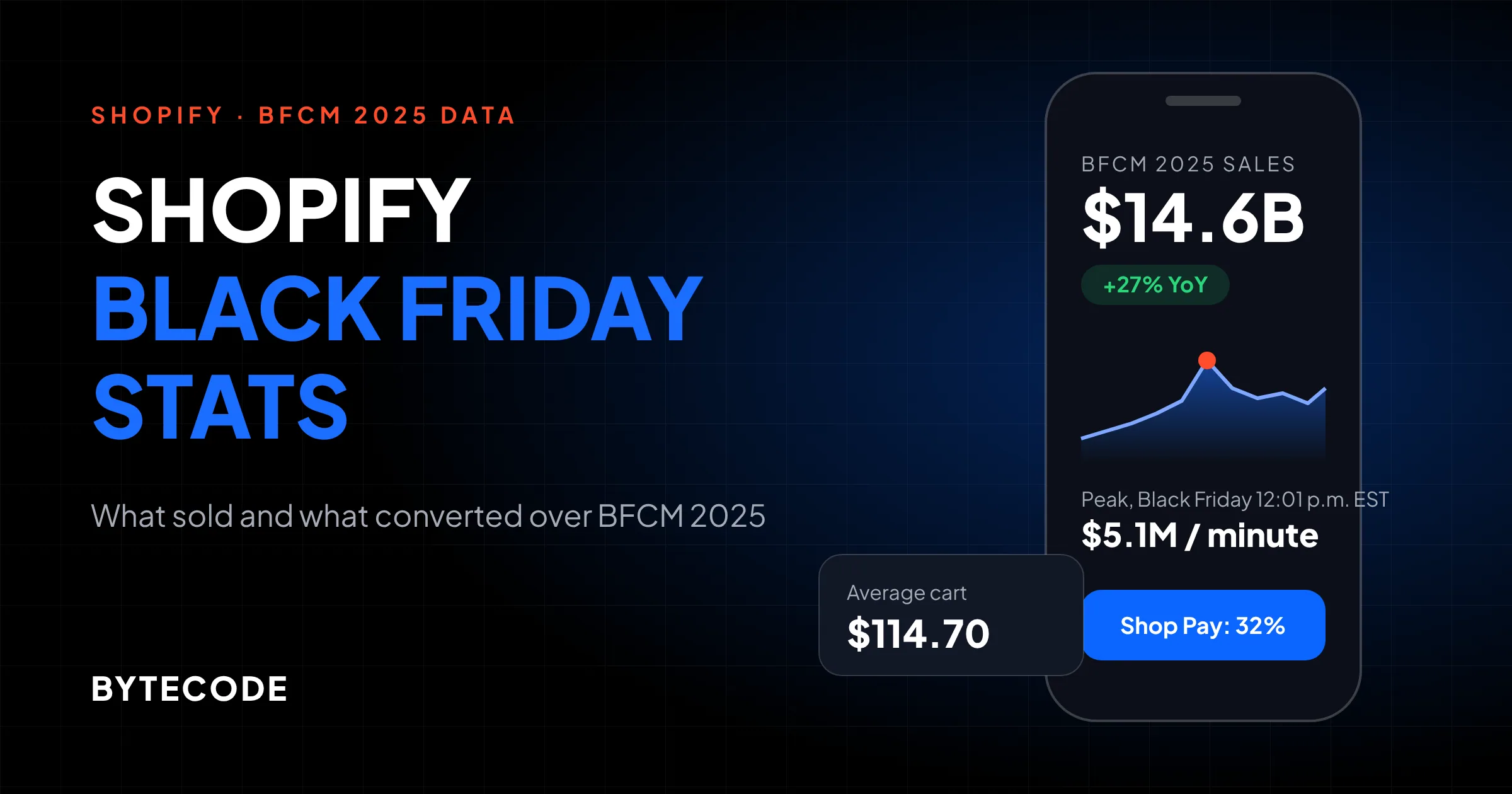
The latest full set of Shopify Black Friday stats covers BFCM 2025: Shopify merchants sold $14.6 billion between Black Friday and Cyber Monday, up 27% on 2024, with sales peaking at $5.1 million a minute just after noon Eastern on Black Friday. That is the final figure in Shopify’s BFCM 2025 results, published on December 2, 2025.
To be clear about the dates: this post is built on 2025 data, because that is the most recent complete weekend anyone has numbers for. We pulled Shopify’s official figures and set them next to Adobe Analytics and Salesforce data on what actually converted: phones, saved wallets, buy now pay later, AI referrals and discount depth. Then we turned it into a short list of changes for your next big weekend.
Update note: BFCM 2026 runs from Black Friday, November 27, to Cyber Monday, November 30, which closes on December 1 when you count every time zone the way Shopify does. We will update this post with the BFCM 2026 numbers in early December 2026, once Shopify, Adobe and Salesforce publish their final figures.
Key takeaways
- Shopify merchants did $14.6B over BFCM 2025, up 27% (24% in constant currency), from 81 million+ shoppers with a $114.70 average cart.
- The wider US market grew much more slowly: Adobe measured Cyber Week at $44.2B, up 7.7%, and Salesforce saw global order volume rise only 2% while prices rose 6%.
- Beauty, apparel basics, activewear and supplements led on Shopify. Market-wide, electronics led.
- The conversion story was checkout speed on phones. Shop Pay handled 32% of Shopify BFCM orders, and Salesforce counted 70% of online orders on mobile.
- AI referral traffic is still small, but Adobe found it converted 31% better than other traffic over the 2025 season.
- Discounts got only slightly deeper. Average Black Friday discounts moved from 22.2% to 23.7%, so the extra revenue did not come from slashing harder.
Shopify Black Friday stats for 2025: the headline numbers
Shopify BFCM sales for 2025 came to $14.6 billion from more than 81 million shoppers, a record for the platform. Every number in the table below comes from Shopify’s newsroom post and its investor press release of the same day. Shopify labels it all approximate and unaudited.
| Metric | BFCM 2025 | What it tells you |
|---|---|---|
| Total sales (online and offline) | $14.6B, up 27% (24% constant currency) | Includes POS, and includes brands that joined Shopify during the year |
| Peak sales rate | $5.1M per minute at 12:01 p.m. EST, Black Friday | The lunchtime spike is the moment your site has to hold up |
| Shoppers | 81M+ unique buyers | Counted by unique email, a new method for 2025 |
| Average cart | $114.70 ($112.29 constant currency) | A useful line to hold your own AOV against |
| Cross-border orders | 16% of global orders | One order in six crossed a border |
| Shop Pay | 32% of orders, sales up 39% | Accelerated checkout is now a third of the weekend |
| Merchants with their best day ever | 94,900+ | Tens of thousands of stores set a personal record |
| Merchants making a first sale | 15,800+ | New stores launched into the busiest weekend |
| Top countries | US, UK, Australia, Germany, Canada | Four English-speaking markets plus Germany |
Two of these deserve a second look. The peak minute climbed from about $4.6 million at a similar point in 2024 to $5.1 million, according to Shopify’s live Black Friday blog, which also quoted President Harley Finkelstein telling CNN that 12% of US ecommerce runs through Shopify that day. And cross-border share looked higher in the middle of Black Friday (18% at noon ET on the live blog) than in the final weekend figure (16%). Overseas buyers shop early in your day.
Shopify did not publish a separate Black Friday-only total in its final release. You will find one quoted around the web, but we could not trace it to a Shopify document, so we have left it out.
Shopify grew three times faster than the market. Read that carefully
Set against the wider Black Friday ecommerce statistics, Shopify’s 27% growth was roughly three times the market’s. Adobe’s Cyber Monday release put US online spending over Cyber Week (Thanksgiving to Cyber Monday) at $44.2 billion, up 7.7%, with Black Friday at $11.8 billion (up 9.1%) and Cyber Monday at $14.25 billion (up 7.1%). Salesforce, tracking 1.5 billion shoppers, measured global Cyber Week sales of $336.6 billion, up 7%, and US sales of $79.6 billion, up 5%.
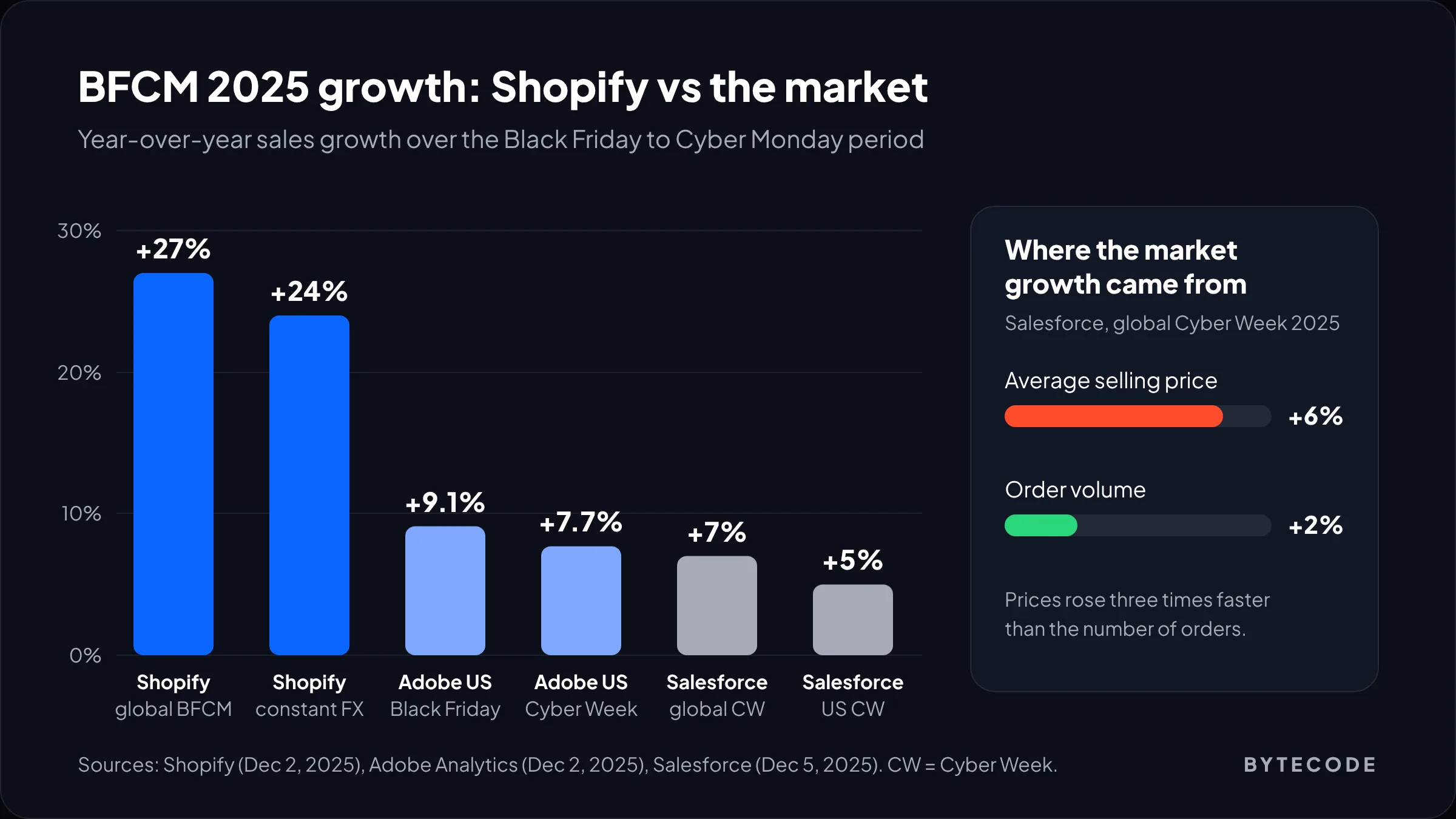
So should a Shopify brand that grew 10% feel bad? No. Shopify’s number is platform GMV. It includes brands that moved onto Shopify during 2025, POS sales and currency effects (hence 24% in constant currency). Your store is not the platform.
The more useful signal is in the Salesforce data. Average selling prices rose 6% while global order volume grew just 2% (1% in the US). Most of the market’s growth came from higher prices, not more orders. If your revenue grew in line with the market, check whether your order count actually moved.
Watch out: do not compare your BFCM revenue with Shopify’s 27% and call the weekend a failure, or a success. Compare your orders, conversion rate and margin with your own prior year, aligned by day of the week. Black Friday was November 28 in 2025 and is November 27 in 2026.
What sold: the categories that led BFCM 2025
On Shopify, beauty and apparel basics led BFCM 2025. Shopify’s final release names cosmetics, clothing tops and pants, activewear, and fitness and nutrition as the hottest categories. The live blog, measured by order count at noon ET on Black Friday, ranked skin care first, then vitamins and supplements, t-shirts, activewear pants and makeup.
The trending products it named fit the same pattern: an Alo Yoga pullover, a Cozy Earth bamboo sheet set, a Merit Beauty blush balm, Lola Blankets, Loop Switch 2 earplugs and a Victoria Beckham eyeliner. Premium DTC brands. Not a single TV.
That is a different picture from the market as a whole. Across US retail, Adobe’s 2025 holiday recap shows electronics as the biggest category for the season at $59.8 billion, then apparel at $49.0 billion and furniture and home goods at $31.1 billion. The fastest-growing were groceries (up 10.2%) and cosmetics (up 9.3%). On Cyber Monday alone, electronics, apparel and furniture made up 57% of online spend.
Why the Shopify mix matters for your offer
Skin care, supplements and basics are replenishable. People buy them again in six or eight weeks. That changes the maths of a BFCM promotion: the first order can run at a thin margin if the second and third orders come at full price. A one-off product like a sofa or a camera does not get that second chance.
Our view: if you sell consumables, treat BFCM as your cheapest acquisition week of the year and build the post-purchase flow before the sale, not after. If you sell durable goods, protect margin harder and sell the upgrade (bigger bundle, premium version, extended warranty) instead of a deeper cut. Adobe saw the share of units sold for the most expensive goods rise 19% across the 2025 season, so buyers were willing to trade up.
What converted: phones, wallets and buy now pay later
The clearest driver of conversion over BFCM 2025 was a fast checkout on a phone. Shopify reported that 32% of BFCM orders went through Shop Pay, with Shop Pay sales up 39%. Salesforce found that mobile devices drove 70% of online orders worldwide during Cyber Week, and mobile wallets were used on 27% of global orders (29% in the US).
Adobe, measuring US transactions rather than orders, saw lower numbers pointing the same way. Mobile took 56.4% of transactions across the 2025 holiday season, 57.5% on Cyber Monday, and 61.6% on Thanksgiving, the first day ever above 60%.
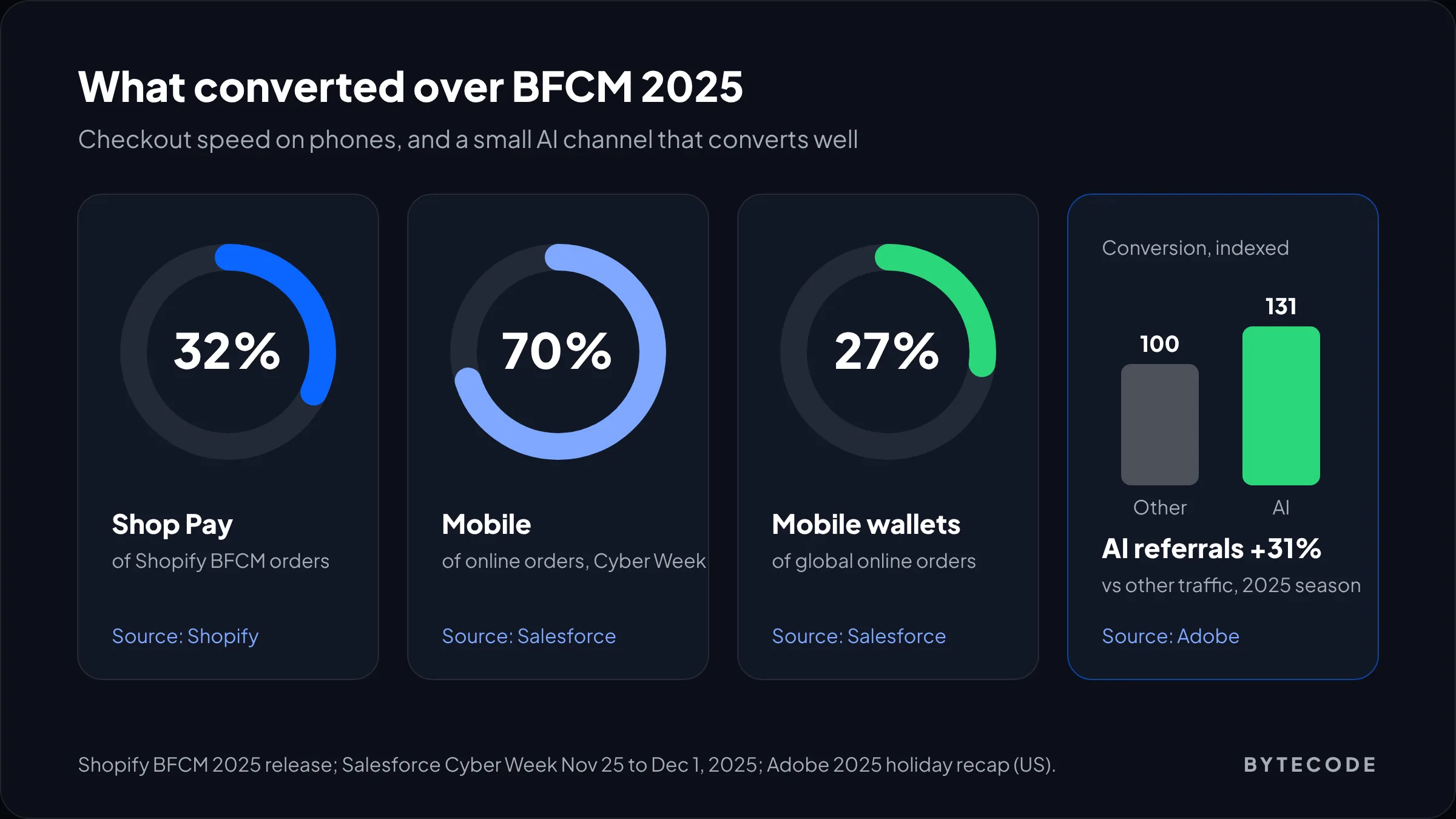
Shop Pay and accelerated checkout
A third of orders through one button is a big share. On most stores we audit, the gap between mobile and desktop conversion is not about the product page. It is about typing: address, card number, a one-time code that lands in another app. Shop Pay, Apple Pay and Google Pay remove that. Check that the dynamic checkout buttons show on the product page and in the cart drawer, not only at checkout (in most Online Store 2.0 themes this is a setting on the product information block and the cart). A cart drawer that waits on three upsell apps before those buttons appear quietly costs orders.
Buy now, pay later
BNPL grew again and lived almost entirely on phones. Adobe counted $20.0 billion of US BNPL spend over the 2025 holiday season, up 9.8%, including $3.1 billion during Cyber Week and a record $1.03 billion on Cyber Monday. Mobile accounted for 82.2% of it.
Our opinion: if your average order is above about $100, show the installment price on the product page under the main price, not only at checkout. Shop Pay Installments, Klarna and Afterpay can all show that message on the product page. If your average order is small, it adds clutter for little gain and we would skip it.
From our team: before BFCM, buy something on your own store from a phone on mobile data, logged out, using the BNPL option. Time it. Then do it again with Shop Pay. If either path takes more than a minute, fix that before you touch a single banner.
AI-driven traffic: small, growing fast, and it converts
Traffic from AI assistants to US retail sites rose 693% over the 2025 holiday season, and those visitors converted 31% better than other traffic, according to Adobe’s holiday recap. The gap was wider on the big days: 38% higher on Black Friday and 54% higher on Thanksgiving. On Cyber Monday itself AI-referred traffic was up 670%.
Keep the scale in proportion: 693% growth from a small base is still a small channel. Adobe also found 73% of AI traffic came from desktop, the opposite of every other pattern here. These are people researching in a chat window, then clicking through ready to buy.
Salesforce gives a much bigger number: AI and agents influenced 20% of global Cyber Week orders, or $67 billion. Read the definition, though. Salesforce counts personalized recommendations and service chat on retailers’ own sites as AI influence, so this measures on-site AI tools, not traffic from ChatGPT or Gemini.
For 2026, Adobe’s September 2026 forecast expects AI traffic to US retail sites to rise another 130%, with Thanksgiving up 159% and Black Friday up 95%. What earns that traffic is mostly product data: complete titles, variant names a human would search for, clean product structured data, and prices and stock status that match what an assistant reads. That is catalog work, and it is boring, and it pays.
Black Friday discount depth: deeper cuts were not the reason people bought
Discounts in 2025 were only slightly deeper than in 2024. Adobe’s recap puts the average Black Friday discount at 23.7%, up from 22.2%, making it the most discounted day of the season. Cyber Monday averaged 22.9% and Thanksgiving 22.7%. Category peaks ran from 30.9% off in electronics to 18.8% in furniture.
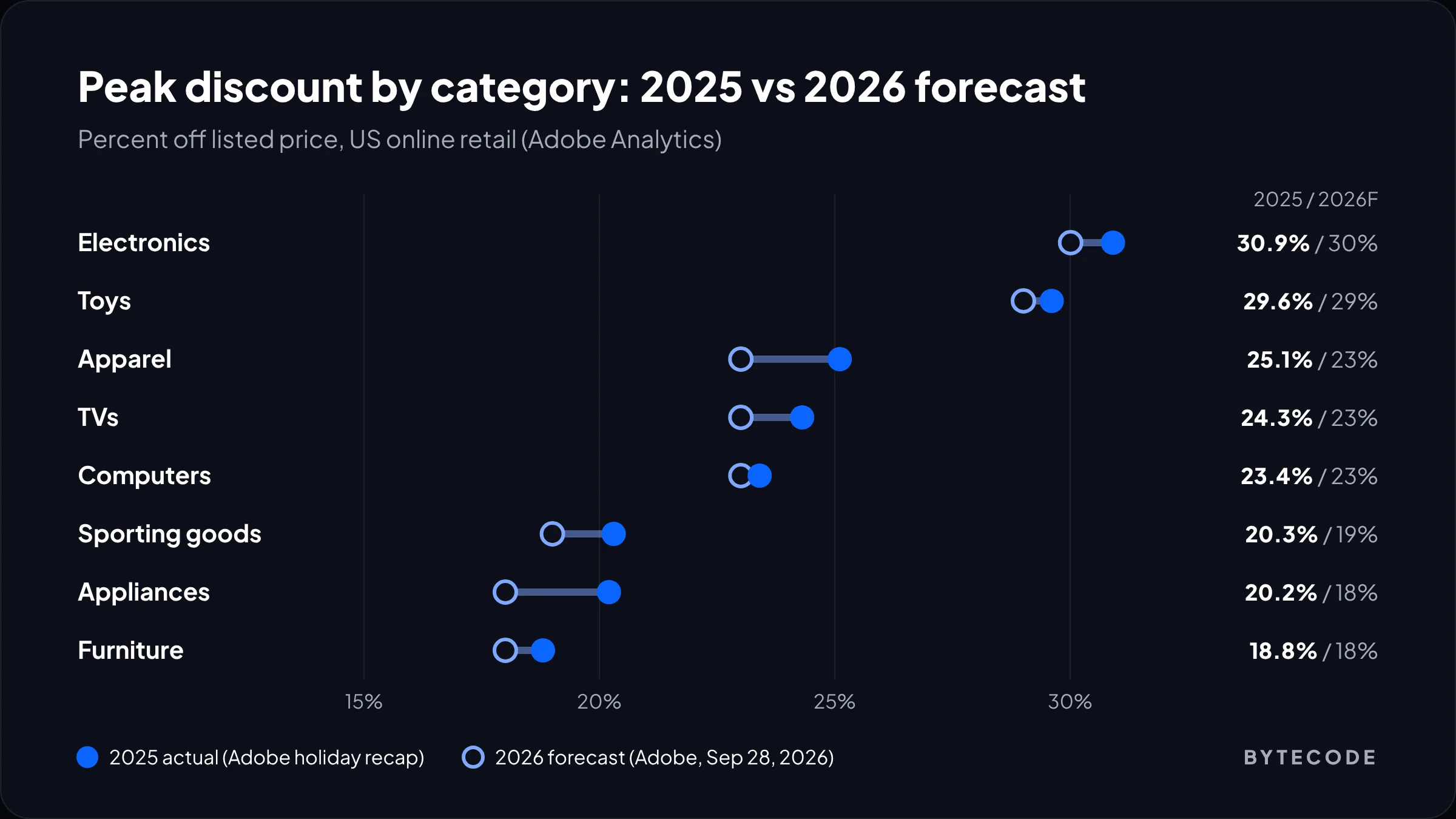
A 1.5-point deeper average discount did not create 27% growth for anyone. Salesforce saw average selling prices go up, not down, and Adobe saw shoppers trading up to pricier items.
Worked example: what an extra 10 points off really costs
This is a hypothetical. Say you sell a $60 serum with a $27 landed cost, so $33 of gross profit at full price. Last year you ran 20% off. Here is how many more units you need at deeper discounts just to make the same gross profit, before shipping, payment fees and returns.
| Offer | Sale price | Gross profit per unit | Units needed to match 1,000 units at 20% off |
|---|---|---|---|
| 20% off | $48 | $21 | 1,000 |
| 30% off | $42 | $15 | 1,400 (+40%) |
| 40% off | $36 | $9 | 2,334 (+133%) |
Going from 20% to 30% off needs 40% more orders to stand still. Market-wide order volume grew 2%. Unless you have evidence your customers were waiting for a bigger number, the safer move is a gift-with-purchase, a bundle or a tiered offer (spend $100, get 25% off) that lifts the cart instead of cutting the unit price.
Want your BFCM numbers read against these benchmarks?
Send us last year’s BFCM export and your planned offers, and we will show you where checkout, speed or offer structure cost you orders.
Book a BFCM review
Lessons for next year
The 2025 data points to five actions, and none of them is “discount more”. In rough order of payoff:
- Make mobile checkout the first project. With 70% of orders on phones and a third of Shopify BFCM orders on Shop Pay, test accelerated checkout buttons on the product page and cart, remove anything that delays them, and run the logged-out phone test above. Our shopify conversion rate optimization audits start here for a reason.
- Load-test the lunchtime peak. The Shopify platform peaked at 12:01 p.m. EST. Shopify scales the checkout, but your theme, apps and third-party scripts do not scale with it. Cut what you can from the product page before November using our guide to Shopify speed optimization.
- Price for margin, merchandise for basket size. Use bundles, tiers and gifts instead of deeper flat cuts, and show BNPL pricing on carts above about $100.
- Get your catalog ready for AI assistants. Clean titles, complete variant data, accurate stock and price. AI referrals converted 31% better in 2025 and Adobe expects the channel to more than double again.
- Plan the second order before the first. Beauty, supplements and basics led on Shopify. Have the replenishment flow and an abandoned checkout sequence live before the sale. Our Shopify abandoned cart guide covers what is actually recovering carts now.
For the timeline, our Shopify store maintenance checklist has a six-week BFCM runway: app audit, discount testing, backups and the code freeze. Do that part in October, not the week before.
[Bytecode client results: to be added] This box is a placeholder for verified BFCM figures from Bytecode client stores. It will be filled in only with numbers our clients have approved for publication.
How to benchmark your own BFCM against these numbers
Compare each metric with your own prior year first, and with the market numbers second. In Shopify admin, everything below is under Analytics > Reports; set the comparison period to the matching days of the week, not the matching dates.
| Your metric | 2025 market reference | Where to look in Shopify | What a gap usually means |
|---|---|---|---|
| Mobile share of orders | 70% of online orders (Salesforce) | Sessions by device type, orders by channel | Well below: check mobile ads and the mobile product page |
| Accelerated checkout share | Shop Pay on 32% of Shopify orders | Finance reports, payments by method or gateway | Well below: buttons hidden, slow or missing in the cart |
| Average order value | $114.70 Shopify average cart | Average order value over time | Depends on category; watch the year-on-year change |
| Cross-border orders | 16% of Shopify orders | Sales by billing location | Low with high overseas traffic: check Markets pricing and duties |
| AI referral sessions | Up 693% (Adobe, season) | Sessions by referrer (chatgpt.com, perplexity.ai, gemini.google.com) | Flat or zero: product data is likely the limit |
| Average discount | 23.7% on Black Friday (Adobe) | Discount reports and sales by discount | Much deeper with flat order growth: margin is leaking |
Report names shift a little between Shopify releases, so search the reports list if one has moved.
If the gaps keep landing on the checkout and product page, that is exactly the scope of our Shopify CRO service, and the fixes we try first are listed in our Shopify conversion rate optimization guide.
Frequently asked questions
How much did Shopify stores sell on Black Friday?
Shopify stores sold $14.6 billion over the Black Friday to Cyber Monday weekend in 2025, up 27% on 2024, according to Shopify. Sales peaked at $5.1 million per minute at 12:01 p.m. EST on Black Friday. Shopify did not publish a separate Black Friday-only total in its final results, so the weekend figure is the official one.
What converts best during BFCM?
Fast mobile checkout with saved payment details converts best during BFCM. In 2025, 32% of Shopify BFCM orders went through Shop Pay, and Salesforce found phones drove 70% of online orders during Cyber Week. Adobe also found AI-referred visitors converted 31% better than other traffic over the season, and BNPL hit a record $1.03 billion on Cyber Monday.
What sold best on Shopify during Black Friday 2025?
Beauty, apparel basics, activewear and supplements sold best on Shopify during BFCM 2025. Shopify named cosmetics, clothing tops and pants, activewear, and fitness and nutrition as the top categories. By order count at noon on Black Friday, skin care ranked first, followed by vitamins and supplements, t-shirts, activewear pants and makeup.
When is Black Friday Cyber Monday 2026?
Black Friday 2026 is Friday, November 27, and Cyber Monday is Monday, November 30. Thanksgiving falls on November 26. Shopify measures BFCM from early Friday in New Zealand to late Monday in California, so its counting window closes on December 1 in UTC. We will add the 2026 results here in early December.
How big were Black Friday discounts in 2025?
The average Black Friday discount in 2025 was 23.7% off list price, up from 22.2% in 2024, according to Adobe. Peak discounts by category ranged from about 31% in electronics and 30% in toys to around 19% in furniture. Adobe’s 2026 forecast expects Cyber Week discounts of up to 30%, roughly level with 2025.
Did AI shopping assistants affect Black Friday sales?
Yes, though AI traffic is still a small channel. Adobe measured a 693% rise in AI-referred visits to US retail sites over the 2025 holiday season, and those visitors converted 31% better than average. Salesforce says on-site AI and agents influenced 20% of global Cyber Week orders, a broader measure that includes recommendations and service chat.
The short version
BFCM 2025 was a record for Shopify merchants, and the stores that did well were not the ones with the deepest discounts. They were the ones where a shopper on a phone could go from product page to paid order in a few taps, with installment pricing visible and a reason to add a second item.
If you only do one thing before November 27, run the phone test: logged out, on mobile data, through to a paid order with Shop Pay and with BNPL. Fix whatever slows you down. Then look at your offer structure and your catalog data, in that order.
We have built and supported Shopify stores for brands like Delsey, EcoFlow, Kerbholz and Maker & Moss. If you want a second pair of eyes on your checkout and offers before the weekend, or a proper read of your results after it, start with our Shopify conversion work.