On this page
- How to use this Shopify glossary
- A: A/B test to App block and app embed
- B: B2B to Bundles
- C: Canvas to Customer accounts
- D: Dawn and Horizon to Draft order
- E: Editions to Expansion store
- F: Fine-tuning to Functions
- G: GA4 to GraphQL
- H: Hallucination to Hydrogen
- I to K: Inventory location to JSON template
- L: Liquid to Loyalty program
- M: Managed Markets to Multi-agent system
- N to O: n8n to Oxygen
- P: Payment customization to Public app
- Q to R: RAG to Redirect
- S: Scripts to Subscriptions
- T to U: Theme app extension to UCP
- V to Z: Variant to WebMCP
- What is the difference between Shopify Plus and Shopify?
- Shopify terminology that changed in 2026
- How the AI glossary terms fit together
- Frequently asked questions
- The short version
Half the questions on a first call with a new brand are really vocabulary questions. A founder has been told she needs “Functions, not Scripts”, her marketing lead wants to “do GEO”, and a developer on the thread is asking whether the metafields are defined yet. This Shopify glossary is the cheat sheet we wish we could send before those calls: 100 Shopify and AI terms, each explained in two or three lines, with a link to our longer guide wherever we have written one.
We kept the definitions short and a little opinionated. Where a term carries a price, a limit or a deadline, we checked it against the owner’s own page in November 2026 and linked it. Shopify renames and retires things often, so dated facts are marked as dated.
Key takeaways
- 100 terms across five areas. 28 of them are AI terms, which tells you where Shopify is spending its roadmap.
- Shopify Plus is the same platform on an enterprise contract: from $2,300 a month on 1- or 3-year terms, with a customizable checkout, B2B catalogs, expansion stores and a lower card rate.
- Three dates to know: Scripts stopped running on June 30, 2026, the current MCP specification is dated July 28, 2026, and public apps need expiring offline tokens by January 1, 2027.
- Google says you need no llms.txt file or special schema to appear in AI Overviews. Clean product data and good SEO are still the job.
- If a Shopify term in a quote is not on this page, ask the vendor to define it in writing before you sign.
Jump to a letter: A · B · C · D · E · F · G · H · I-K · L · M · N-O · P · Q-R · S · T-U · V-Z · Shopify vs Plus · FAQ
How to use this Shopify glossary
Every term sits under its first letter, with quiet letters grouped (I to K, Q to R). Each entry says what the thing is first, then what we would tell you on a call: when it matters, when to skip it, or what tends to go wrong. Unlike a general ecommerce glossary, this one only covers Shopify terms and the AI vocabulary that now shows up in Shopify briefs.
The 100 terms fall into five areas:
- Storefront and themes (19): Liquid, sections, JSON templates, metafields, metaobjects, Core Web Vitals.
- Checkout, payments and orders (13): Checkout Extensibility, Shop Pay, transaction fees, chargebacks.
- Apps and developer platform (17): Functions, Hydrogen, the Admin and Storefront APIs, access tokens, webhooks.
- Plans, operations and growth (23): Plus, Markets, B2B, Flow, POS, AOV and conversion rate.
- AI, agents and search (28): LLMs, RAG, MCP, UCP, Sidekick, GEO and the rest of the agentic commerce vocabulary.

From our team: projects go wrong on vocabulary long before they go wrong on code. A brief that says “custom checkout” can mean a gift-note extension or a whole new payment flow, and those are quotes an order of magnitude apart. As a shopify development agency, the first thing we do with any brief is rewrite it in the terms below and send it back for a yes.
A: A/B test to App block and app embed
A/B test
Splitting traffic between two versions of a page, price or offer and keeping the one that sells more. Shopify’s Fall ’26 Edition added scheduled rollouts and A/B tests for themes, discounts and catalogs inside the admin. Small samples lie, so let tests run.
Abandoned checkout
A checkout where the shopper entered contact details and left before paying. Shopify lists these under Orders > Abandoned checkouts and can email a recovery link automatically. What actually brings them back: our abandoned cart recovery guide.
Access token
The credential an app sends with every API call to prove a merchant installed it. Per Shopify’s changelog, every public app must use expiring offline tokens, which last 60 minutes and rotate, from January 1, 2027. Custom apps are exempt. Details in our offline token deadline explainer.
Admin API
The GraphQL API that apps and integrations use to read and write store data: products, orders, customers, inventory, discounts. When someone says their ERP sync or reporting tool “talks to Shopify”, this is almost always what it talks to.
Agentic commerce
Selling through AI agents that search, compare and buy for a shopper. The Fall ’26 Edition describes a shop skill that lets agents such as ChatGPT and Claude find products and check out with Shop Pay. Getting your catalog ready: agentic commerce on Shopify.
Agentic plan
A $0-a-month Shopify plan for selling only in AI channels. According to Shopify’s pricing page, you add products to Shopify’s Catalog, pick the AI channels and pay online card rates from 2.9% + 30¢ when something sells. Fine for testing demand.
AI agent
Software that uses a language model to decide its next step and call tools until a goal is met, instead of just replying. A chatbot explains the refund policy. An agent can issue the refund, which is why it needs limits. See what AI agents are.
AI Overviews
Google’s AI-written answer at the top of some results, with links to the pages it drew on. Google’s guidance says there is no special markup to add: the page has to be indexed and eligible for a snippet. For local stores, see local SEO for AI search.
AI shopping assistant
A chat or voice helper on your storefront that answers product questions, recommends items and can add to cart. Good ones are grounded in your catalog and policies. Bad ones invent sizes. Build or buy: AI shopping assistants on Shopify.
AOV (average order value)
Revenue divided by orders over a period. In a hypothetical month, $48,000 from 800 orders is a $60 AOV. Bundles, free-shipping thresholds and post-purchase offers push it up. Blanket discounts often push it the wrong way.
API version
Shopify releases its APIs as dated versions, named like 2026-10, with a new one every quarter. Each version is supported for a fixed window and then retired, so an app nobody upgrades eventually breaks on Shopify’s schedule, not yours. Budget a few hours a quarter per custom app.
App block and app embed
The two ways a modern app adds things to an Online Store 2.0 theme without editing theme code. App blocks sit inside sections you can move in the theme editor. App embeds load site-wide, for chat widgets or tracking. Uninstall the app and both disappear cleanly. More in our app bloat audit.
B: B2B to Bundles
B2B
Selling wholesale from the same Shopify admin with company profiles, catalogs (price lists), quantity rules and payment terms such as net 30. Shopify’s Plus page lists unlimited B2B catalogs on Plus. Setup walkthrough: Shopify B2B and wholesale.
Bundles
Selling several products as one item, either a fixed kit or a mix-and-match set. Shopify’s free Bundles app and most bundle apps now build on Functions, so stock comes off each component correctly. Check how your 3PL sees a bundle before launch.
C: Canvas to Customer accounts
Canvas
A whole-store design view listed in the Fall ’26 Edition that lets you see and edit the store as one piece instead of template by template. It is new. We would try it on a duplicate theme before touching the live one.
Catalog (Shopify Catalog)
Shopify’s product index that AI channels draw on to find and recommend products. The Agentic plan works by adding your products to it. Clean titles, complete variants and filled-in metafields decide how well you show up, far more than any AI-specific trick.
Chargeback
A cardholder disputes a charge with their bank and the money is pulled back while you argue your case. You respond from the order with tracking and proof of delivery. Fraud filters and a recognisable billing descriptor prevent most. Our fraud prevention checklist covers the rest.
Checkout Extensibility
Shopify’s upgrade-safe way to customize checkout: checkout UI extensions for what shoppers see, Functions for the logic, plus branding settings and web pixels. The Plus page lists a fully customizable checkout on Plus. Lower plans get less. Details in our checkout customization guide.
Checkout UI extension
A small app component that renders inside checkout at set points: a gift note field, a delivery date picker, a loyalty balance. It runs sandboxed, so it cannot break the payment step or slow it the way injected checkout scripts used to.
checkout.liquid
The old Plus-only template file for editing checkout code directly. Shopify has retired it in favour of Checkout Extensibility. If an audit still turns up checkout.liquid code in your theme, treat it as dead code: whatever it did has to be rebuilt as extensions or Functions.
Collection
A group of products. Manual collections are hand-picked. Smart (automated) collections fill themselves from conditions like tag, vendor, type or price. Most of the catalog mess we clean up started with tags being used as a filing system nobody wrote down.
Combined Listings
A Plus feature that groups separate products, each with its own URL, images and data, so they show as one product with options, usually colours. It is listed on the Plus pricing page. Useful when each colourway deserves its own search landing page.
Context window
The amount of text, counted in tokens, a language model can consider at once: your instructions, any documents and its own reply. Bigger windows cost more per call. Stuffing the whole catalog into a prompt is nearly always worse than retrieving the ten products that matter.
Conversion rate
Orders divided by sessions. A hypothetical store with 40,000 sessions and 720 orders converts at 1.8%. The number only means something against your own history and your vertical, so start with our conversion rate benchmarks by industry.
Core Web Vitals
Google’s three field metrics for page experience: Largest Contentful Paint (loading), Interaction to Next Paint (responsiveness) and Cumulative Layout Shift (visual stability). On Shopify the usual culprits are oversized hero images, app scripts and web fonts. Fixes, in order: Shopify speed optimization.
CRO (conversion rate optimization)
Finding what stops visitors buying, changing it and proving the change worked. Real CRO starts with analytics, session recordings and customer questions, not a list of button colours copied from a blog. Our CRO playbook lists the changes that tend to move numbers.
Custom app
An app built for one store and installed from the admin or Dev Dashboard instead of the App Store. It skips App Store review and is exempt from the 2027 token rule. When one is worth building and what it costs: custom Shopify app development.
Customer accounts
The logged-in area where shoppers see orders, addresses and subscriptions. Shopify’s newer customer accounts sign people in with a one-time email code instead of a password and accept UI extensions. Legacy accounts are the old password model. Starting today, pick the new ones.
D: Dawn and Horizon to Draft order
Dawn and Horizon
Shopify’s free reference themes. Dawn was the first Online Store 2.0 theme, and Horizon is the newer family built around more flexible blocks. Free does not mean basic: a well-configured free theme often beats a heavy paid one on speed. Our shortlist: best Shopify themes.
Delivery customization
A Shopify Function that hides, renames or reorders shipping options at checkout, for example hiding express shipping for PO boxes or oversized items. Before Functions, this kind of rule needed a Ruby script and a Plus plan.
Dev Dashboard
Shopify’s developer console for creating apps, managing app versions and spinning up development stores. The Fall ’26 Edition lists a refreshed Dev Dashboard. Apps a merchant creates there for their own store count as custom apps and are exempt from the expiring token deadline.
Draft order
An order you build in the admin on a customer’s behalf, for phone orders, quotes or one-off pricing, then send as an invoice with a checkout link. Wholesale teams lean on draft orders heavily until they move to proper B2B catalogs.
E: Editions to Expansion store
Editions (Shopify Editions)
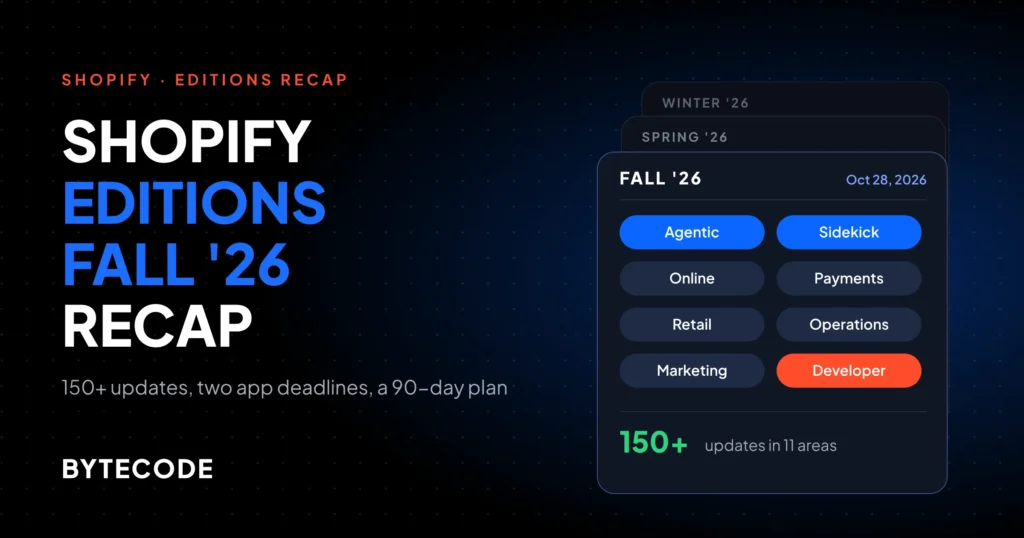
Shopify’s twice-yearly bundle of product announcements. The latest is Fall ’26, titled Exponential, which centres on agentic commerce, Sidekick and a refreshed admin. Merchants read the keynote. Read the developer section too, because that is where deprecations hide.
Embeddings
Lists of numbers that represent the meaning of a piece of text or an image, so similar things sit close together. They power semantic search (“a summer dress for a beach wedding”) and RAG.
ERP integration
Connecting Shopify to the system that runs finance, stock and purchasing, such as NetSuite, SAP, Odoo or Microsoft Dynamics. The hard part is deciding which system owns each field, not moving the data. We lay out that ownership map in Shopify ERP integration.
Expansion store
An extra Shopify store under one Plus organization, used for a separate region, brand or wholesale site. The Plus pricing page includes up to 9 at no extra cost. Since Markets matured, many brands no longer need one just to sell abroad.
F: Fine-tuning to Functions
Fine-tuning
Training an existing model further on your own examples so it picks up a tone, a format or a narrow skill. It will not teach a model this week’s prices; RAG does that. See fine-tuning vs RAG vs prompt engineering.
Flow (Shopify Flow)
Shopify’s built-in automation tool: a trigger, some conditions and an action, such as tagging high-risk orders or pinging Slack when stock runs low. It is free and badly underused on most stores we audit. Twenty workflows to copy: Shopify Flow automations.
Fulfillment order
The record that tells one location or service what to ship from an order. One order can split into several fulfillment orders when items leave from different warehouses. 3PL and ERP integrations work at this level.
Functions (Shopify Functions)
Small pieces of custom backend logic Shopify runs on its own infrastructure for discounts, shipping options, payment methods, cart validation and bundles. They replaced Scripts. Any plan can use Functions shipped in App Store apps, while Functions in a custom app need Plus. Migration notes: Scripts to Functions.
G: GA4 to GraphQL
GA4 (Google Analytics 4)
Google’s event-based analytics. On Shopify you connect it through the Google & YouTube app or a custom pixel. Purchase numbers that do not match Shopify’s are normal and mostly fixable. How we set it up so the numbers hold: Shopify GA4 setup.
GEO (generative engine optimization)
Making your pages the source that AI answers cite, in ChatGPT, Perplexity, Gemini or AI Overviews. It overlaps heavily with good SEO: clear answers near the top, real expertise, crawlable text, accurate structured data. Our version of the playbook: generative engine optimization.
GMV (gross merchandise value)
The total value of orders before returns, fees and costs. Platforms and investors quote it because it is the biggest number. Your accountant cares about net revenue, and so should your margin model.
GraphQL
A query language where the app asks for exactly the fields it needs in one request. Shopify’s Admin and Storefront APIs are GraphQL-first, so a Shopify developer today needs it about as much as Liquid.
H: Hallucination to Hydrogen
Hallucination
When a model states something false with confidence, like a 60-day return window you do not offer. Grounding answers in your own data and testing with real questions cuts it sharply. See building a website chatbot customers don’t hate.
Headless commerce
Running Shopify as the backend while a separate front end, such as Hydrogen or Next.js, renders the store. You gain design freedom and lose the theme editor and most theme apps. Whether it pays off: headless Shopify with Hydrogen.
Human in the loop
An AI setup where the model drafts or proposes and a person approves before anything changes. It is slower than full autonomy and it is how we would run any agent that can touch prices, refunds or customer emails until it has a long clean record.
Hydrogen
Shopify’s React framework for building headless storefronts, built on React Router and deployed to Oxygen. Pick it when content or interaction needs go past what a theme can do. Do not pick it because someone told you headless is automatically faster.
I to K: Inventory location to JSON template
Inventory location
Any place Shopify tracks stock: a warehouse, a shop, a 3PL or a pop-up. Each location holds its own quantities and can be set to fulfil online orders or not. The Plus page lists 200 inventory locations on Plus.
JSON template
The Online Store 2.0 file, such as templates/product.json, that lists which sections appear on a page and their settings. Because layout lives in JSON, marketers can rearrange pages in the editor without a developer. Moving an older theme over: Online Store 2.0 migration.
L: Liquid to Loyalty program
Liquid
Shopify’s open-source template language: the {{ product.title }} and {% if %} tags inside every theme file. It renders on Shopify’s servers, which is a big part of why Liquid themes stay quick as long as app scripts are kept in check.
LLM (large language model)
The kind of AI model behind ChatGPT, Claude and Gemini, trained on huge amounts of text to understand and generate language. On its own it knows nothing about your store. Tools, retrieval and protocols like MCP are what connect it to your data.
LLM observability
Logging and watching what your AI features do in production: prompts, answers, tool calls, latency, cost per conversation and failure rate. Without it, a sudden bill or a bad answer is a mystery. What to track: LLM observability.
llms.txt
A proposed plain-text file at your site root that points AI tools to your most useful pages. Google says AI Overviews need no such file. Cheap to add, not a ranking lever. Our view: llms.txt and AI crawlers.
Loyalty program
Points, tiers or perks that reward repeat purchases, usually run through an app that stores balances against the customer and shows them at checkout. A simple program people understand beats a clever one they ignore. Build vs buy: Shopify loyalty programs.
M: Managed Markets to Multi-agent system
Managed Markets
Shopify’s option where it, with partner Global-e, acts as merchant of record on international orders and handles duties, import taxes and local compliance for a fee. The Fall ’26 Edition lists managed international markets under payments. Redo the maths once volume grows.
Markets (Shopify Markets)
The settings that let one store sell internationally with local currencies, languages, domains and prices, found under Settings > Markets. Start with one or two markets and get pricing and duties right before adding ten. Full setup: Shopify Markets.
MCP (Model Context Protocol)
An open standard for plugging AI applications into tools and data through MCP servers. The July 28, 2026 specification made the core stateless, so any request can reach any server instance behind a load balancer. Explained for non-engineers: Model Context Protocol.
Metafield
A custom field attached to a product, variant, collection, customer, order or the shop itself, for data Shopify has no box for: fabric, care instructions, a size chart. Defined under Settings > Custom data with a type, so themes and apps can use them. Examples: metafields and metaobjects explained.
Metaobject
A custom content type you define once and reuse, like a designer profile, an ingredient or a store location, each with its own fields. A metafield adds data to one thing. A metaobject is a thing in its own right that many products can point to.
Multi-agent system
Several AI agents with separate jobs (research, drafting, checking) passing work between them under an orchestrator. Powerful for long processes and much harder to debug than one agent with good tools. Start with one. When to add more: multi-agent systems.
N to O: n8n to Oxygen
n8n
An open-source workflow automation tool you can self-host, often used to wire Shopify webhooks to AI models, spreadsheets and CRMs. It competes with Zapier and Make, comes out cheaper at volume and asks more of whoever maintains it. Comparison: n8n vs Zapier vs Make.
Online Store 2.0
Shopify’s theme architecture built on JSON templates, sections on every page, app blocks and metafield-driven dynamic sources. If your theme predates it, every new feature costs more to add than it should.
Order status page
The page shoppers land on after paying and come back to for tracking, first shown as the thank you page. It is customized through checkout UI extensions now, which makes it a good home for post-purchase surveys and referral offers.
Oxygen
Shopify’s hosting for Hydrogen storefronts, running on edge servers close to shoppers. Deploying there usually means no separate hosting bill from Vercel or AWS, and one less vendor to call when the site is down.
P: Payment customization to Public app
Payment customization
A Function that hides, renames or reorders payment methods at checkout, such as hiding cash on delivery above a set order value or showing invoice terms only to B2B buyers.
PDP (product detail page)
The page for a single product. Most buying decisions happen here, so photography, variant pickers, delivery promises and reviews earn their keep on the PDP more than anywhere else. Our PDP teardown goes element by element.
Plus (Shopify Plus)
Shopify’s enterprise plan, from $2,300 a month on 1- or 3-year terms per the Plus pricing page. It adds checkout control, unlimited staff, expansion stores, B2B catalogs and lower card rates. Full comparison below and in Shopify Plus vs Advanced.
POS (Shopify POS)
Shopify’s point-of-sale app and hardware for shops and pop-ups, sharing products, stock and customers with the online store. POS Pro adds staff roles and deeper store features, and Plus includes POS Pro for 20 locations. Hardware and setup: Shopify POS for omnichannel retail.
Prompt engineering
Writing and structuring the instructions you give a model (rules, examples, output format) so it behaves predictably. It is cheap and fast to iterate on. Fix the prompt before anyone mentions fine-tuning.
Prompt injection
An attack where text the AI reads, such as a product review, an email or a web page, contains instructions that hijack it. Any agent that reads customer content and can act needs hard limits.
Public app
An app distributed through the Shopify App Store for any merchant to install. It goes through Shopify’s review and has to follow platform rules, including expiring offline access tokens from January 1, 2027.
Got a quote full of terms you can’t check?
Send it over and we will mark up what each line means, roughly how many hours it should take and what looks missing, usually within two working days.
Get a second opinion on your quote
Q to R: RAG to Redirect
RAG (retrieval-augmented generation)
Before answering, the system searches your own content (catalog, policies, help docs) and hands the relevant pieces to the model. It is the standard fix for bots that make things up, and it keeps answers current without retraining. Explained properly: what RAG is.
Rate limit
The cap on how many API requests an app can make in a given time. Big catalog syncs and bulk price updates hit it first. The Plus plan raises limits up to 10x on select APIs.
Redirect (URL redirect)
A rule that sends an old URL to a new one with a 301, managed in the admin’s URL redirects screen or by bulk CSV import. On a replatform, missing redirects is the fastest way to lose rankings. Our WooCommerce to Shopify migration checklist covers mapping them.
S: Scripts to Subscriptions
Scripts (Shopify Scripts)
Ruby snippets Plus stores used to change discounts, shipping and payment options at checkout. Per Shopify’s changelog, editing froze on April 15, 2026 and every Script stopped running on June 30, 2026. Functions replaced them.
Section
A reusable, configurable block of a theme page (a hero, a featured collection, an FAQ) that merchants add and reorder in the theme editor. Building good custom sections is most of what theme work means today. What is safe to change: Shopify theme customization.
Shop app
Shopify’s consumer app where shoppers track orders, follow brands and check out with Shop Pay. The Fall ’26 Edition adds universal checkout across brands and cart sync between Shop and online stores.
Shop Pay
Shopify’s accelerated checkout, which remembers a shopper’s details across every Shopify store, with Shop Pay Installments in supported regions. Leave it switched on. It is one of the cheapest conversion wins on the platform.
Shopify Audiences
A Plus-only tool, listed on the Plus pricing page, that builds higher-intent ad audiences from Shopify’s commerce data for your paid campaigns. Measure it with a holdout before you trust the dashboard.
Shopify CLI
The command-line tool developers use to create apps and themes, preview a theme locally with shopify theme dev and deploy extensions. If your agency is editing live theme code in the browser instead, ask why.
Shopify Magic
Shopify’s set of built-in generative AI features across the admin: product descriptions, email copy, image edits and more. Treat what it writes as a first draft that still needs your brand voice and a fact check.
Shopify Payments
Shopify’s own payment processor. On the pricing page, US online card rates are 2.9% + 30¢ on Basic, 2.7% + 30¢ on Grow and 2.5% + 30¢ on Advanced. Using it also avoids the third-party transaction fee.
Shopify Protect
Shopify’s fraud and chargeback protection, listed in the Fall ’26 Edition for fraud blocking and chargeback support. Read exactly which orders qualify before you switch off your own fraud review.
Sidekick
Shopify’s AI assistant inside the admin. The Fall ’26 Edition says it now handles multi-step technical tasks, tests recommendations with SimGym and sits as a floating chat across the admin. Check its work on pricing. More: Shopify Sidekick and Shopify Magic.
SimGym
A Fall ’26 feature that runs simulated shoppers against Sidekick’s store recommendations before you apply them. A useful sanity check. A real A/B test with real customers still settles the argument.
SKU (stock keeping unit)
Your internal code for one sellable variant, like TEE-BLK-M. Keep SKUs unique and consistent: ERPs, 3PLs and marketplaces match on them, and duplicate SKUs cause the nastiest sync bugs we get called in to fix.
Storefront API
The shopper-facing GraphQL API for custom shopping experiences: product data, carts and the hand-off to checkout. Hydrogen storefronts, mobile apps and many AI shopping tools read your store through it.
Structured data
Schema.org markup, usually JSON-LD, that tells search engines what a page is: a product, its price, its availability, its reviews. Most themes output some. Google wants it to match the visible page, and AI features need no special schema. The SEO side: Shopify SEO.
Subscriptions
Recurring orders built on Shopify’s selling plans and run by an app such as Shopify Subscriptions or Recharge. Choose the app on how it handles failed payments, skips and swaps, not on its dashboard. Our subscriptions guide has the checklist.
T to U: Theme app extension to UCP
Theme app extension
The package an app uses to deliver app blocks and embeds to a theme without touching theme code. Ask every app vendor whether they use one. If they still inject code into theme.liquid, uninstalling them leaves debris behind.
Theme editor
The visual customizer under Online Store > Themes > Customize, where you add sections, change settings and preview. A well-built theme gives marketers enough control here that most page changes never need a developer.
Token (AI)
The unit models read and bill in, a chunk of text that is often shorter than a word. API prices are quoted per million tokens, so long prompts and chatty agents cost real money at scale. Ways to cut it: reducing LLM API costs.
Transaction fee
Shopify’s extra charge when you use a third-party gateway instead of Shopify Payments: 2% on Basic, 1% on Grow, 0.6% on Advanced and 0.2% on Plus, per the pricing page. It sits on top of whatever your gateway charges.
UCP (Universal Commerce Protocol)
An open standard co-developed by Shopify and Google so AI agents can discover what a merchant supports and complete a purchase. Merchants publish their capabilities at a well-known URL, agents publish theirs, and the two work out the overlap. Etsy, Target, Walmart and Wayfair are listed supporters.
V to Z: Variant to WebMCP
Variant
One buyable version of a product, such as size M in black, with its own price, SKU, barcode and stock. Options (size, colour, material) define the variants. Products with huge option matrices are where Combined Listings or separate products start to make sense.
Vector database
A database that stores embeddings and finds the nearest matches fast, such as Pinecone, Weaviate or Postgres with pgvector. It is the retrieval half of most RAG systems. For a catalog of a few thousand products, pgvector on the database you already run is usually enough.
Vibe coding
Building software by describing it to an AI tool (Lovable, Bolt, Replit, Cursor) and accepting what it generates. Great for prototypes and internal tools. Production needs code review, tests and a security pass. How we take prototypes live: vibe coding to production.
Webhook
A message Shopify sends to your app when something happens, such as orders/create or products/update, so the app does not have to keep polling. A sound integration verifies the HMAC signature and expects the same event to arrive twice.
WebMCP
An emerging browser proposal that lets a web page expose its own actions as tools for an AI agent running in the browser. Shopify’s Fall ’26 Edition lists WebMCP tools among its developer updates. Early days. Worth watching, not yet worth building a roadmap around.
What is the difference between Shopify Plus and Shopify?
Shopify Plus runs on the same platform, admin and themes as every other Shopify plan. The difference is the contract and what it switches on. Basic, Grow and Advanced cost $29, $79 and $299 a month on yearly billing per Shopify’s pricing page. Plus starts at $2,300 a month on a 1- or 3-year term, according to the Plus pricing page, and adds checkout control, B2B depth, extra stores and lower rates.
| Plan | Price per month | US online card rate (Shopify Payments) | Third-party gateway fee | Staff accounts |
|---|---|---|---|---|
| Basic | $29 yearly billing, $39 monthly | 2.9% + 30¢ | 2% | No additional accounts |
| Grow | $79 yearly billing, $105 monthly | 2.7% + 30¢ | 1% | Up to 5 additional |
| Advanced | $299 yearly billing, $399 monthly | 2.5% + 30¢ | 0.6% | Up to 15 additional |
| Plus | From $2,300, 1- or 3-year term | 2.25% + 30¢ | 0.2% | Unlimited |
The Plus pricing page lists what the extra money buys. These are the lines we see actually change a project:
- A fully customizable checkout, and Shopify Functions inside your own custom app rather than only through App Store apps.
- Up to 9 expansion stores at no extra cost, for separate regions, brands or a wholesale storefront.
- Unlimited B2B catalogs.
- Combined Listings, Shopify Audiences and bot protection for high-demand launches.
- API rate limits up to 10x higher on select APIs, which matters most for ERP-heavy stores.
- 200 inventory locations, POS Pro for 20 locations (up to 200 with Shopify Payments) and up to 25 headless storefronts.

Here is the sum most comparison pages skip. Moving from Advanced on yearly billing to Plus costs ($2,300 minus $299) times 12, or $24,012 a year, and saves 0.25 points on online card sales. The saving covers the fee at about $9.6M a year in online card revenue. Below that, you are paying for features. Our rule of thumb: under roughly $1M in revenue with no B2B, checkout or multi-store need, stay on Grow or Advanced. The build costs that come with Plus are in our Shopify development cost guide.
Watch out: Plus is a term contract. The Plus page says you can cancel once the 1- or 3-year commitment expires, not before. Get the term, the renewal terms and any revenue-based fee in writing before you compare features, because the feature list will not change after signing and the price might.
Shopify terminology that changed in 2026
Six dated changes explain most of the new or retired Shopify terminology above. If a guide you are reading predates them, check its advice against this list.
| Date | What happened | Terms affected |
|---|---|---|
| January 11, 2026 | Shopify Engineering published the Universal Commerce Protocol, co-developed with Google | UCP, agentic commerce |
| April 15, 2026 | Shopify Scripts could no longer be edited or published | Scripts, Functions |
| June 30, 2026 | All Shopify Scripts stopped running | Scripts, delivery and payment customization |
| July 28, 2026 | MCP specification 2026-07-28 made the protocol stateless and deprecated Dynamic Client Registration | MCP |
| Autumn 2026 | Fall ’26 Edition introduced Canvas, SimGym, WebMCP tools and a new Sidekick | Canvas, SimGym, Sidekick, WebMCP, Catalog |
| January 1, 2027 | Expiring offline access tokens required for all public apps | Access token, public app |
How the AI glossary terms fit together
The AI terms make more sense as layers than as a list. A model (the LLM) does the reasoning. Retrieval (RAG, built on embeddings and a vector database) gives it your facts. Protocols (MCP for tools and data, UCP for commerce) let it act. Shopify supplies the catalog, the cart and the checkout underneath.
Follow one purchase through the stack. This is a hypothetical example, not a client story:
- A shopper asks an assistant for waterproof hiking boots under $150 in a size 10.
- The assistant’s LLM breaks the request into steps. It is now acting as an AI agent, not a chatbot.
- It searches product data from Shopify’s Catalog, where your titles, variants and metafields decide whether your boot even matches.
- It checks what your store supports through a protocol layer, such as the capabilities a merchant publishes under UCP.
- It completes payment with Shop Pay, and the order lands in your admin like any other, with the channel recorded.

Your own storefront assistant uses the same layers, pointed inward: RAG over your catalog and policies, tools such as order lookup through MCP or an API, and a human in the loop for anything involving money. Every layer adds tokens, and tokens are the bill, so LLM observability belongs in the first release.
From our team: before you spend on any AI channel, fix the product data. Clear titles, consistent variant names, filled-in metafields and honest structured data feed Shopify Catalog, Google’s AI features and your own assistant at once. On most catalogs we audit, that cleanup does more for AI visibility than any new tool.
Frequently asked questions
What does a Shopify term like metafield mean?
A metafield is a custom field that stores information Shopify has no built-in box for, such as fabric, care instructions or a size chart, on a product, variant, collection, customer, order or the shop. You create its definition under Settings > Custom data and pick a type. Themes, filters and apps can then display or use that data.
What is the difference between Shopify Plus and Shopify?
Shopify Plus is Shopify’s enterprise plan on the same platform, starting at $2,300 a month on 1- or 3-year terms, compared with $29 to $299 a month for Basic, Grow and Advanced on yearly billing. Plus adds a fully customizable checkout, unlimited staff, up to 9 free expansion stores, unlimited B2B catalogs and a lower 2.25% + 30¢ online card rate.
What are Shopify Functions used for?
Shopify Functions are used to customize backend logic such as discounts, shipping options, payment methods, cart validation and bundles, and they run on Shopify’s own infrastructure. They replaced Shopify Scripts, which stopped running on June 30, 2026. Any plan can use Functions that come inside App Store apps, while Functions built into a custom app need Shopify Plus.
What is the difference between GEO and SEO?
SEO aims to rank your pages in search results, while GEO aims to get your content cited inside AI-generated answers from ChatGPT, Perplexity or Google’s AI Overviews. The work overlaps heavily. Google says its AI features need no special markup beyond being indexed and eligible for a snippet, so clear answers, real expertise and accurate structured data serve both.
What is MCP in simple terms?
MCP, the Model Context Protocol, is an open standard that lets AI assistants connect to tools and data through one common interface instead of a custom integration for each. Its current specification, dated July 28, 2026, made the protocol stateless so it scales behind ordinary load balancers. Shopify publishes MCP servers for developers and storefronts.
Do I need an llms.txt file on my Shopify store?
No, you do not need an llms.txt file to appear in Google’s AI Overviews or AI Mode. Google’s guidance says no AI text files, special markup or extra schema are required beyond being indexed and eligible for a snippet. Adding one is cheap and harmless, but product data, crawlability and clear answers deserve your time first.
The short version
You do not need to memorise 100 terms. You need about fifteen of them to read a quote properly: theme, section, metafield, metaobject, app block, Checkout Extensibility, Functions, Markets, B2B, Plus, custom app, Admin API, Flow, RAG and MCP. Learn those and you can tell when an agency is pricing a gift-note extension as if it were a checkout rebuild, or selling you an “AI strategy” that is really a chatbot with no retrieval behind it.
For the rest, bookmark this page. We update it when Shopify ships a new Edition or retires something.
We have built and supported Shopify stores for brands like Delsey, EcoFlow, Kerbholz and Maker & Moss, and more of that work now sits at the line between Shopify and AI. If you want a team that speaks both halves of this glossary, start on the Bytecode homepage and see how we work.